


Cold-chain meal kits on FedEx: where dry ice declarations and transit-time windows actually break
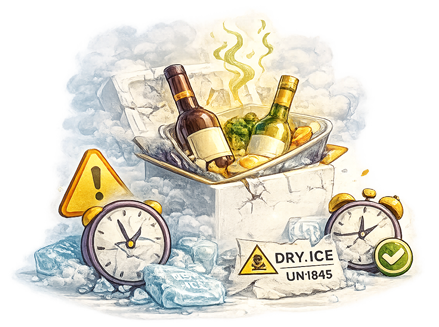
A meal kit company ships 8,000 boxes nationwide on Mondays and Tuesdays. Each box has dry ice in an insulated liner keeping frozen ingredients at temperature. The Monday batch routes FedEx Priority Overnight for delivery Tuesday — Wednesday morning at the latest. A Tuesday-shipped box to a remote zip code routes through a less-direct path. By the time it arrives Thursday afternoon, the dry ice has sublimated, the ice packs are warm, and the food inside has been at unsafe temperatures for several hours. The customer photographs the warm box, contacts support, and gets a refund. The merchant absorbs the box cost, the food cost, the support time, and the negative review.
Across cold-chain DTC — meal kits, frozen seafood, premium cheese subscriptions, ice cream brands, biotech sample shipments — this failure mode is one of the structural risks of the category. The carrier capability to prevent it exists: FedEx Specialty Cargo and Express service tiers support cold-chain shipments with the appropriate transit-time windows, dry ice handling is well-established on the regulatory side, and the Ship API accepts the required UN1845 declarations cleanly. The integration layer is where the workflow consistently breaks — either through wrong service-tier routing, missed declarations, or transit-time miscalculation against the cold-chain window.
This article describes what cold-chain DTC actually requires from the carrier workflow, where the integration consistently breaks, and what the workflow needs to do for frozen and refrigerated shipments to arrive at temperature.
Shipping cold-chain DTC through FedEx involves a stack of operational requirements:
These requirements aren’t optional. The integration layer is responsible for making them flow per shipment without per-order intervention from the operations team — at scale, manual handling becomes operationally fragile and the failure modes become recurring.
Three patterns show up consistently across cold-chain DTC merchants:
1. UN1845 dry ice declaration missed on a share of shipments. The most common compliance failure. The merchant’s fulfillment team uses a printed label workflow where the dry ice declaration is added per shipment via an “add hazmat” toggle. On most orders the toggle gets checked; on some it gets missed. The package leaves the dock without the UN1845 declaration on the manifest. At the FedEx hub, the package is flagged for missing hazmat documentation — either held until the declaration is corrected (delay), or accepted as a regulatory non-compliance (risk to the merchant). The fix is SKU-level metadata: products containing dry ice are tagged once at the product catalog level, and every shipment carrying those SKUs has the UN1845 declaration attached automatically with net weight calculated from the box configuration.
2. Service tier doesn’t match the cold-chain window for the destination. The merchant configures Priority Overnight as the default service tier. The Priority Overnight network is fast enough for most destinations but misses the window for remote zip codes where the network’s actual transit can be two days. The merchant’s box thermal design holds for 36 hours; the actual transit is 48 hours. The box arrives warm. The fix is route-aware service-tier selection at the rate-quote step — the integration checks the destination’s transit-time window against the box’s cold-chain capacity and either routes through a faster service tier or blocks the order at checkout for destinations that can’t meet the window.
3. Cutoff time missed because of label-generation timing. The fulfillment team prints the day’s cold-chain labels at the end of the shift, but the FedEx Express cold-chain pickup cutoff was hours earlier. Packages built today won’t ship until tomorrow, which adds a day of in-transit time, which breaks the cold-chain window. The fix is the integration’s pickup-cutoff awareness — labels for cold-chain shipments are flagged for cutoff-time pickup scheduling, and orders received after the cutoff are queued for tomorrow’s batch rather than printed today for shipment that won’t actually move until tomorrow.
These three patterns explain most of the warm-box and held-shipment outcomes in the cold-chain DTC merchant base.
The workflow that doesn’t break tags dry-ice-using SKUs at the product catalog level, calculates net dry-ice weight per box from the box configuration, and attaches the UN1845 declaration to the FedEx manifest for every applicable shipment automatically. Service-tier routing checks destination transit-time against the cold-chain window at the rate-quote step and selects the right tier per order. Pickup-cutoff awareness flags orders for the right shipping batch rather than letting late-in-the-day orders get printed but not shipped.
For the merchant, the operational flow stays the same — pick, pack, label, hand off — but the integration handles the cold-chain-specific requirements behind the scenes. The fulfillment team doesn’t manage hazmat declarations per shipment. The service-tier choice for each destination is automatic. The pickup schedule matches actual shipping departure rather than label-print time.
At meal kit volume — 5,000-15,000 boxes per week — manual handling of these requirements is operationally fragile. The compounding effect of even a 1-2% per-shipment failure rate becomes a meaningful share of the operations team’s monthly time on compliance corrections, hazmat re-routing, and warm-box customer-support tickets.
Cold-chain DTC continues to grow across multiple verticals — meal kits, frozen seafood, premium cheese, ice cream, gourmet specialty foods, biotech samples, pharmaceutical compounds. The category has scaled meaningfully through 2024-2025 as DTC-native cold-chain brands have launched alongside traditional cold-chain logistics.
For FedEx Specialty Cargo and the cold-chain team, this is the segment where carrier capability and merchant operational reality align — Priority Overnight and First Overnight transit-time guarantees, established dry ice handling protocols, and well-defined cold-chain routing have been part of FedEx’s specialty portfolio for years. The integration-layer adoption across Shopify and WooCommerce is where the gap usually sits, particularly for mid-market cold-chain DTC brands that don’t have dedicated logistics teams to coordinate the workflow manually.
Cold-chain DTC workflow automation still feels like one of the under-built capability areas across Shopify and WooCommerce shipping infrastructure for meal kit, frozen DTC, and biotech cold-chain merchants.
Happy to connect with anyone on the FedEx Specialty Cargo / Cold Chain side exploring cold-chain DTC workflow automation further.
This article reflects patterns observed across PluginHive’s cold-chain DTC merchant base on FedEx. IATA Dangerous Goods Regulations and 49 CFR dry ice rules update annually; verify current IATA, ICAO, and PHMSA documentation before commercial commitments. FedEx cold-chain service-tier availability and transit-time guarantees vary by origin / destination and should be verified against current FedEx Specialty Cargo documentation.
PluginHive shipping solutions for FedEx integration on WooCommerce and Shopify.

Direct FedEx integration for WooCommerce — addresses the workflow gaps covered in this article.
Shopify app with native FedEx integration — addresses the workflow gaps covered in this article.
Multi-carrier label generation for Shopify across FedEx and other carriers — addresses the workflow gaps covered in this article.