


If you run a Shopify store and ship with FedEx, U.S. fuel surcharges can quietly eat into your profits without you realising it. Fuel prices fluctuate regularly, and because FedEx adjusts its fuel surcharge weekly based on diesel or jet fuel indexes, your shipping costs can change from one week to the next, even if your base rates stay the same. These surcharges are applied not just to the shipping rate but often to additional fees as well, which means the total impact on your margins can be higher than expected. For Shopify sellers offering free shipping or flat-rate shipping, this unpredictability makes pricing strategy difficult, since a shipment that was profitable last week could generate lower margins this week. In this guide, we’ll break down how fuel surcharges work across Ground, Express, International, and Freight services, and what that means for your overall shipping costs and profitability.
In This Article:
- How FedEx Determines Fuel Surcharges in the U.S. for Shopify Shipping
- Current U.S. FedEx Fuel Surcharge Rates (2026 Snapshot)
- What FedEx Charges Are Fuel-Applicable on Shopify Shipping?
- How Fuel Surcharges Impact Shopify Shipping Costs
- How To Stay Ahead of FedEx Fuel Fluctuations in Shopify
- How to Protect Shopify Profit Margins from FedEx Fuel Fluctuations
- Conclusion
- FAQ’s
How FedEx Determines Fuel Surcharges in the U.S. for Shopify Shipping
Diesel-Based Fuel Surcharge (Ground Services)
For ground shipments, FedEx calculates the fuel surcharge using the weekly U.S. on-highway diesel fuel price published by the U.S. Department of Energy. This diesel-based model applies to:
- FedEx Ground
- FedEx Home Delivery
- FedEx International Ground
- Pickup services
- FedEx Freight (LTL and FTL)
FedEx uses a trigger table structure, which works like this:
- Each diesel price range (price per gallon)
- Corresponds to a specific fuel surcharge percentage
- When diesel moves into a new range, the surcharge percentage automatically adjusts
Example:
- Diesel price: $3.55–$3.64 = 21.50% surcharge
- Diesel price: $3.64–$3.73 = 21.75% surcharge
If the national average diesel price crosses into a higher bracket, your fuel surcharge increases the following week.
Jet Fuel–Based Fuel Surcharge (Air & Express Services)
For air and express shipments, FedEx uses a different benchmark: the weekly U.S. Gulf Coast spot price for kerosene-type jet fuel. This jet fuel–based surcharge applies to:
- Domestic package services
- U.S. to Puerto Rico shipments
- Express freight services
- Export shipments
- Import shipments
This model also follows a tiered percentage structure, meaning:
- Each jet fuel price range triggers a specific surcharge percentage
- Some freight services use a per-pound fuel charge instead of a percentage
- Changes are reviewed and adjusted weekly
For Shopify sellers, this means Express and international air shipments tend to have higher and sometimes more volatile fuel impacts compared to diesel-based Ground deliveries.
Current U.S. FedEx Fuel Surcharge Rates (2026 Snapshot)
FedEx Ground & Home Delivery (Diesel-Based %)
- As of the latest 2026 update, FedEx Ground and FedEx Home Delivery fuel surcharges are 21.75%, based on the most recent weekly U.S. on-highway diesel fuel index.
- FedEx reviews that index each week, and if diesel prices move into a new pricing bracket, the surcharge adjusts accordingly.
Domestic Package Services (Jet Fuel %)
- For domestic package services, including U.S. to Puerto Rico shipments, the current fuel surcharge is 20.75%.
- Unlike Ground, which relies on diesel pricing, these services follow jet fuel pricing tiers. If jet fuel prices move up or down into a different trigger range, the percentage changes automatically.
Express Freight (Per-Pound Fuel Charge)
- Express freight services use a weight-based fuel surcharge model instead of a flat percentage. The current rate is approximately $0.528 per billable pound.
- For example: 100 lb shipment × $0.528 = $52.80 fuel surcharge
- Billable weight is critical here. If the dimensional weight exceeds the actual weight, FedEx uses the higher figure. So larger, lightweight packages can significantly increase your total fuel surcharge.
International Fuel Surcharge
- International shipments carry higher fuel percentages compared to domestic services. Current rates are approximately:
- Export: 25.00%
- Import: 28.75%
- Imports often have higher percentages because they reflect different cost structures, routing complexity, and international air transport variables.
FedEx Freight (LTL & FTL)
- For FedEx Freight shipments (both LTL and FTL), the current fuel surcharge is around 32.90%.
For more information on FedEx fuel surcharges, check out U.S. fuel surcharges page.
What FedEx Charges Are Fuel-Applicable on Shopify Shipping?
When most Shopify sellers look at fuel surcharges, they assume the percentage is applied only to the base shipping rate. But with FedEx, that’s not the case. Fuel is often calculated on more than just the transportation charge, which is why invoices can feel higher than expected.
For Ground Shipments
For FedEx Ground, Home Delivery, and International Ground shipments, the fuel surcharge applies to:
- The net package rate
- Additional Handling fees
- Residential Delivery charges
- Demand surcharges
- And other applicable surcharges
Here’s how it works in simple terms: FedEx first adds up your base shipping rate and any extra fees tied to the shipment. Then the fuel surcharge percentage is applied to that combined total, not just the base rate.
For Express & International Shipments
For Express and international shipments, the structure is similar. Fuel applies to:
- Dangerous Goods fees
- Residential Delivery
- Saturday Delivery
- Temporary surcharges
Again, the fuel percentage is calculated on the shipping rate plus these additional charges. The more service add-ons a shipment has, the higher the total fuel charge becomes.
For Freight Shipments
For FedEx Freight (LTL and FTL), the fuel surcharge is applied broadly to:
- Linehaul transportation charges
- Other fuel-consuming services
In freight shipping, because the transportation charges themselves are larger, even a small increase in the diesel percentage can significantly raise the total cost.
How Fuel Surcharges Impact Shopify Shipping Costs
Fuel surcharges directly affect what you pay per order, and for Shopify sellers using FedEx, even small percentage changes can reduce margins quickly. Here’s how it plays out in real scenarios.
Real Example – Ground Shipment
Let’s say you ship a domestic order via FedEx Ground:
- Base rate: $14.00
- Residential fee: $4.50
- Additional handling: $3.00
Subtotal before fuel: $21.50
If the diesel-based fuel surcharge is 21.75%:
$21.50 × 21.75% = $4.68
Final shipping cost: $26.18
If you charged the customer $22 flat shipping, you’ve absorbed over $4 on that order. Across dozens or hundreds of shipments, that adds up fast.
Real Example – Express Freight
Express freight uses a per-pound fuel charge.
- Billable weight: 120 lbs
- Fuel rate: $0.528 per lb
Fuel charge: 120 × $0.528 = $63.36
That amount is added to your freight cost. Since FedEx uses billable (often dimensional) weight, larger packages can significantly increase the fuel portion of the invoice.
International Example – Export vs Import
International shipments carry higher percentages:
- Export: 25.00%
- Import: 28.75%
On a $200 shipment:
- Export fuel = $50
- Import fuel = $57.50
That 3.75% gap can noticeably impact margins for cross-border Shopify stores, especially if you offer competitive or flat international shipping rates.
How To Stay Ahead of FedEx Fuel Fluctuations in Shopify
When fuel surcharges change weekly, the real problem isn’t just higher costs, it’s unpredictability. That’s where PH Ship, Rate & Track for FedEx comes into the picture.
Here’s how it protects your margins:
- Real-time carrier-calculated rates
Customers see accurate FedEx rates (including fuel) at checkout, so you’re not undercharging when diesel or jet fuel spikes.

- Automatic rate adjustments
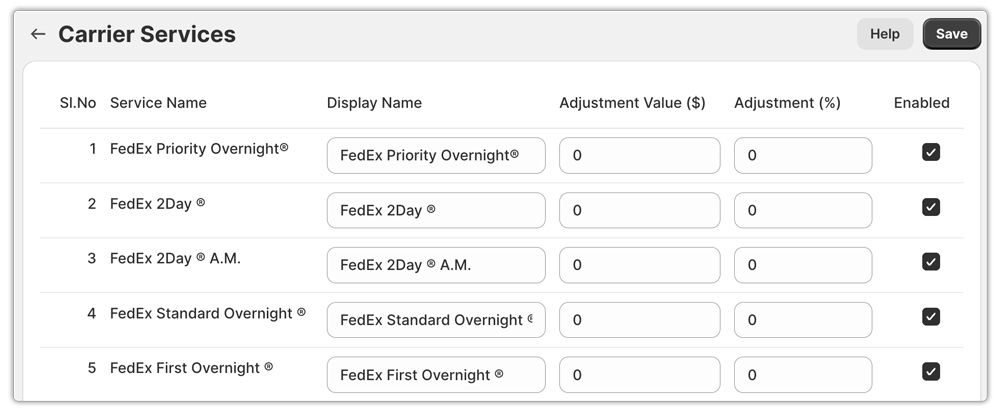
Since fuel surcharges update weekly, manual rate settings quickly become outdated. You can also manually adjust those prices to reflect a value you want, which also covers your margin
- Dimensional weight accuracy
Because fuel applies to billable weight in many cases, accurate weight and packaging configuration inside the app, including FedEx boxes, helps prevent costly miscalculations.

How to Protect Shopify Profit Margins from FedEx Fuel Fluctuations
- Optimise packaging to reduce billable weight
Smaller, right-sized packaging lowers dimensional weight. Since fuel is calculated as a percentage of shipping charges. - Choose Ground vs. Express strategically
Express and air shipments are tied to jet fuel pricing and typically carry higher, more volatile fuel surcharges. If delivery speed isn’t critical, using Ground can significantly reduce both base rate and fuel impact. - Enable calculated shipping rates in Shopify
Instead of relying on flat shipping rates, use real-time carrier-calculated rates. This ensures updated fuel surcharges are reflected at checkout so you’re not absorbing unexpected increases. - Monitor weekly fuel surcharge trends
Fuel surcharge percentages are updated weekly based on diesel and jet fuel indexes. Keeping track of these changes helps you anticipate cost shifts instead of being surprised by higher invoices.
Fuel fluctuations are unavoidable, but with the right shipping strategy, you can control how much they affect your profitability.
Conclusion
Fuel surcharges aren’t just a small add-on; they’re a variable cost that can quietly shrink your margins if you’re not actively managing them. Because FedEx updates fuel surcharges weekly based on diesel and jet fuel indexes, your shipping costs can shift from one week to the next, even when your base rates stay the same. And since fuel applies to more than just the transportation charge, the impact is often bigger than most Shopify sellers expect.
The key is staying proactive instead of reactive. Smart packaging, strategic service selection, negotiated discounts, and real-time rate visibility all help you stay in control.
This is where PH Ship, Rate & Track for FedEx makes a real difference. Pulling live carrier-calculated rates directly into your Shopify checkout, it ensures current fuel surcharges are already factored in. That means no outdated flat rates, no manual adjustments every week, and fewer surprises on your invoices. You’re not guessing you’re charging accurately.
Fuel prices will continue to move. But with the right tools and strategy in place, your margins don’t have to.
FAQ’s
Q. Why does FedEx change fuel surcharges every week?
FedEx adjusts fuel surcharges weekly because it ties them to national fuel indexes, diesel for Ground services and jet fuel for Express services. Since fuel prices fluctuate regularly, the surcharge percentage moves up or down depending on those published averages.
Q. Are fuel surcharges applied only to the base shipping rate?
No, and this is where many Shopify sellers get surprised. Carriers usually apply fuel charges to the base rate plus several additional surcharges, such as residential delivery, additional handling, oversize fees, and more. So the total fuel impact is often higher than expected.
Q. Why are Express and international shipments more expensive due to fuel charges?
Express and international services are tied to jet fuel pricing, which tends to be more volatile than diesel. On top of that, international shipments typically carry higher fuel percentages. That combination makes air and cross-border shipping more sensitive to fuel price swings.
