



Where carrier APIs and eCommerce UX diverge: the freight-in-storefront problem on Shopify and WooCommerce
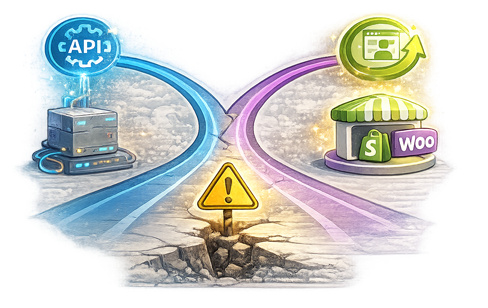
Most multi-carrier shipping apps on Shopify and WooCommerce were architected around the parcel-default model — single package, single rate, single tracking number. The carrier APIs underneath them weren’t. FedEx’s Rate, Ship, and Track APIs have always handled parcel and freight, multi-piece shipments, accessorials, hazmat declarations, customs identifiers, and service-tier eligibility through the fdx developer platform. The carrier-side data model matches the operational reality of multi-carrier eCommerce at production volumes; the integration-layer abstraction often doesn’t.
The Shopify and WooCommerce checkout UX inherited the parcel-default model because parcel is what most eCommerce ships, and the platform’s job is to make checkout simple for the majority case. A single “calculate shipping” button. A flat rate response. A single tracking number per shipment. The integration layer between the platform UX and the carrier API is where the workflow either translates cleanly across both shapes — or doesn’t.
This article describes where the gap between carrier capability and eCommerce UX consistently shows up, what the translation layer needs to do to honor both shapes, and what the integration-layer pattern looks like when it holds up.
The FedEx Rate, Ship, and Track APIs expose a deep capability set that most checkout UX doesn’t reach into:
Each of these capabilities lives on the carrier API surface. The platform-side eCommerce UX abstracts most of them into “shipping cost at checkout, single tracking number after shipment” — the parcel-default shape. The translation layer either honors the carrier depth or flattens it.
Three patterns show up consistently across mid-market merchants on Shopify and WooCommerce who outgrow parcel-default integrations:
1. Freight rate quotes returned as parcel quotes (or failed silently). The most common failure. The integration’s rate-engine call doesn’t recognize when an order exceeds parcel thresholds and should be routed to the Freight LTL endpoint. Some integrations return parcel quotes at unusable prices because dimensions trip parcel surcharges. Others fail silently and the merchant’s checkout shows no rate. Buyers either complete checkout at the wrong price or abandon because the shipping option doesn’t appear. The fix is freight-aware rate routing — orders exceeding parcel thresholds route to the Freight Rate API automatically with the right inputs.
2. Accessorial pricing not exposed at checkout. Liftgate, residential, inside delivery, Saturday delivery, adult signature, Hold at Location — each is an accessorial the FedEx Rate API returns at quote time when called correctly. Most multi-carrier shipping apps don’t show them at checkout, either because the integration doesn’t call the Rate API with the right accessorial selection or because the platform-side checkout abstraction doesn’t have UI affordances for buyer-selectable accessorials. The buyer sees a base rate that doesn’t reflect what the delivery actually requires; the merchant absorbs the gap or appears to over-charge.
3. Multi-piece logic collapses into a single label. Multi-piece shipments require the master / piece structure to be preserved end-to-end — from rate quote to label generation to tracking. Integrations that flatten multi-piece into a single shipment lose the piece-level detail at every step. Drivers pull only the labeled box at pickup. Per-box accessorials get applied incorrectly. Per-box DG / hazmat / customs declarations don’t differentiate. The buyer-facing tracking shows one shipment per label rather than one shipment with piece-level status.
These three patterns explain why merchants who scale beyond simple parcel DTC consistently end up running parallel manual workflows for the non-parcel cases.
The workflow that doesn’t break honors both shapes. Parcel-default orders flow through the standard rate-quote-to-label-to-track loop with single-package logic. Orders that exceed parcel thresholds (freight, multi-piece, accessorial-heavy, regulated cargo) route through a freight-aware extension that pulls the right inputs at quote time and exposes accessorial choices at checkout where the buyer can act on them.
For freight specifically, the rate quote calls the FedEx Freight Rate API with pallet count, freight class, dimensions, and accessorial selection. The Ship API call carries the multi-piece structure, the per-box accessorials, and the bill-to handling correctly. The tracking flow preserves master / piece relationships. The buyer-facing checkout shows freight as a first-class option rather than as parcel-with-bigger-numbers.
For accessorial selection, the buyer-facing checkout exposes the choices the order genuinely allows — liftgate or no-dock, Saturday or weekday, Hold at Location vs residential — with the per-accessorial cost from the FedEx Rate API. The buyer chooses; the integration writes the selection to the manifest; the cost reflects reality at invoice time.
For mid-market merchants whose mix is meaningfully non-parcel — DTC furniture with residential freight, wine clubs with multi-piece + adult signature, B2B-on-Shopify with wholesale LTL, regulated cargo merchants with DG and hazmat — the difference between integration-layer support for both shapes and parcel-default flattening shows up directly in operations-team time, customer experience consistency, and the percentage of orders that need parallel manual workflows.
The gap between what carrier APIs can do and what eCommerce platform UX abstracts is one of the more durable differentiators in shipping integration. The carrier capability has been outpacing the eCommerce UX layer for years; closing that gap requires integration-layer architecture that explicitly honors both the parcel-default model and the deeper carrier surface.
For FedEx fdx Developer Platform and Compatible Solutions Program, this is one of the conversations where joint visibility with integrator partners would move the integration-layer adoption picture across the broader Shopify and WooCommerce ecosystem. The fdx documentation has been improving; the carrier API surface keeps deepening; the integration-layer adoption is where the variation across the shipping-app ecosystem actually sits.
Carrier API to eCommerce UX translation depth still feels like one of the under-built capability areas across Shopify and WooCommerce shipping infrastructure as merchant mix continues to diversify beyond parcel-default DTC.
Happy to connect with anyone on the fdx Developer Platform / Compatible Solutions side exploring eCommerce shipping UX integration depth further.
This article reflects patterns observed across PluginHive’s mid-market merchant base on Shopify and WooCommerce. FedEx Rate, Ship, and Track API specifics evolve — verify current fdx Developer Platform documentation before commercial commitments. Platform-side checkout abstraction details on Shopify and WooCommerce continue to evolve as both platforms invest in shipping-related extensibility.
PluginHive shipping solutions for FedEx integration on WooCommerce and Shopify.

Direct FedEx integration for WooCommerce — addresses the workflow gaps covered in this article.
Shopify app with native FedEx integration — addresses the workflow gaps covered in this article.
Multi-carrier label generation for Shopify across FedEx and other carriers — addresses the workflow gaps covered in this article.