


The US tariff on Canada has become a major factor in the US-Canada trade relationship over the past 18 months. What began as a 25% tariff on Canadian goods in February 2025 has evolved into a layered regime of multiple tariff authorities, Canadian retaliatory surtaxes, and, as of September 29, 2026, outright import bans on certain Canadian products. For Shopify merchants on both sides, the impact is higher costs, supply disruptions, tighter margins, and unexpected customs charges.
Table of Contents
- US Tariff on Canada: Full Timeline of the Tariff Escalation
- Section 338: What It Means for the US Tariff on Canada
- Which Products Are Affected by the US Tariff on Canada?
- USMCA: What It Still Covers and Where It No Longer Protects You
- How the US Tariff on Canada Affects Shopify Merchants
- Problem 1: How the US Tariff on Canada Is Changing Landed Costs
- Problem 2: How the US Tariff on Canada Is Compressing Shipping Margins
- Problem 3: How the US Tariff on Canada Is Affecting Cross-Border Fulfillment
- Problem 4: How the US Tariff on Canada Is Affecting Canadian Customers
- Problem 5: The September 29 Import Ban Creates Immediate Compliance Risk
- Conclusion
- FAQs
US Tariff on Canada: Full Timeline of the Tariff Escalation
- Feb 1, 2025: The U.S. announced a new 25% tariff on most Canadian imports and a 10% tariff on Canadian energy products under IEEPA.
- Mar 7, 2025: Canadian goods that qualified under USMCA became exempt from these additional tariffs.
- Aug 1, 2025: The tariff on non-USMCA Canadian goods increased to 35%. Goods routed through Canada to avoid tariffs became subject to a 40% rate.
- Jul 20, 2026: The U.S. issued three Section 338 proclamations, adding a 50% duty on certain Canadian products linked to disputes involving dairy, alcohol, and motor vehicles.
- Aug 22, 2026: These Section 338 tariffs took effect after a short negotiation delay. Unlike IEEPA tariffs, USMCA status did not exempt affected products.
- Aug 25, 2026: Canada announced matching counter-tariffs on selected U.S. goods.
- Sep 8, 2026: Canada’s retaliatory tariffs took effect, covering about C$27.6 billion worth of U.S. products. The U.S. also announced changes to some Section 338 product lists.
- Sep 15, 2026: Updated Section 338 lists came into effect, adding some products and removing others.
- Sep 29, 2026: Additional U.S. import restrictions on specified Canadian products are scheduled to take effect.
Section 338: What It Means for the US Tariff on Canada
Section 338 is a provision within the Tariff Act of 1930 that authorises the President to impose additional duties of up to 50% on goods from any country found to discriminate against US commerce. It had not been used at this scale before August 2026. Three separate proclamations each targeted a distinct dispute with Canada: Canada’s supply-managed dairy system, provincial restrictions on US alcohol sales (which drove an ~81% drop in Canadian imports of US alcoholic beverages), and declining US motor vehicle exports to Canada.
Two critical points for Shopify merchants:
- Section 338 is additive; the 50% stacks on top of existing MFN duties, IEEPA tariffs, and other applicable charges. The September 8 proclamations removed the anti-stacking rule, so Section 338 and Section 232 tariffs now stack when both apply.
- Section 338 has no fixed expiration date and remains in force until modified or revoked.
Which Products Are Affected by the US Tariff on Canada?
Section 338 is tied to disputes over alcohol, dairy, and motor vehicles but can cover a broader range of Canadian products.
The exact products covered are determined by their HTSUS codes listed in the official proclamation annexes. This means a product that does not appear directly related to alcohol, dairy, or vehicles may still be subject to the additional 50% duty if its HTSUS code is included in the Section 338 tariff lists.
The lists cover products across categories such as food and beverages, dairy products, chemicals, plastics, cosmetics, wood and paper products, metals, machinery, electronics, furniture, agricultural equipment, textiles, clothing, and sporting goods, among others.
Certain products are excluded from the Section 338 measures, including energy, potash, fish, critical minerals, civil aircraft goods, and products covered by certain Section 232 tariffs. However, this does not mean those products are completely tariff-free. Some remain subject to separate Section 232 duties.
The safest way to determine whether a product is affected is to check its HTSUS code against the relevant Section 338 lists. The September 8, 2026 proclamation also changed the lists by adding some products and removing others, with the revised scope taking effect September 15.
USMCA: What It Still Covers and Where It No Longer Protects You
Many businesses shipping between the U.S. and Canada rely on USMCA rules to reduce or eliminate tariffs. The new Section 338 measures change an important part of that approach.
Where USMCA still helps
- IEEPA Canada tariff: Goods that qualify for USMCA treatment remain exempt from the additional IEEPA tariff that applies to non-USMCA Canadian goods.
- Section 301: USMCA qualification can also remain relevant to the treatment of goods under the separate Section 301 measures, subject to the specific exemptions and rules that apply.
Where USMCA does not help
Section 338 is different. The U.S. government states that the additional 50% Section 338 tariffs apply to covered Canadian goods regardless of whether they qualify under USMCA.
So, a product can have a valid USMCA claim and still face the additional Section 338 duty if its HTSUS code is included in the covered product lists.
| Tariff layer | USMCA treatment |
|---|---|
| MFN/base duty | Depends on the product |
| IEEPA Canada tariff | USMCA can exempt qualifying goods |
| Section 301 | Depends on the applicable Section 301 rules |
| Section 338 | USMCA does not exempt covered goods |
What this means for merchants
Continue maintaining proper USMCA documentation and certification where applicable. USMCA can still affect other tariff layers and may reduce the overall duty burden.
However, do not assume that a USMCA certificate eliminates the Section 338 duty. If the product is covered by the Section 338 HTSUS lists, the additional 50% duty can still apply.
How the US Tariff on Canada Affects Shopify Merchants
Understanding the tariff rules is only part of the picture. For Shopify merchants shipping between the US and Canada, these changes can affect much more than the amount of duty paid. They can change landed costs, shipping margins, fulfilment decisions, and what customers end up paying at delivery.
The following sections break down the key problems merchants are likely to face and the practical steps they can take to manage them.
Problem 1: How the US Tariff on Canada Is Changing Landed Costs
The problem: Shopify merchants sourcing from Canada had their landed cost models invalidated on August 22. The 50% Section 338 duty stacks on top of existing tariffs, applies regardless of USMCA status, and covers far more product categories than the headline disputes suggest.
Workarounds:
- Run a line-by-line HTS review for every Canadian-sourced product — do not assume coverage or exclusion based on category name
- Recalculate landed costs with the full tariff stack applied and identify which product lines remain viable at current retail pricing
- If your products are on the list and the 50% makes Canadian sourcing permanently unviable, begin exploring alternative supply origins. Section 338 has no expiration date
- If you use bonded warehouses, verify with your customs broker whether goods were admitted in privileged foreign status before August 22, or whether they inherit the new duty on consumption entry
For context on how duties interact with carrier costs as total landed cost, the UPS international shipping guide for Shopify covers the full picture for cross-border shipments.
Problem 2: How the US Tariff on Canada Is Compressing Shipping Margins
The problem: Even for merchants whose products are not on the Section 338 annex, the trade disruption has pushed carrier surcharges and cross-border lane costs upward. Reduced US-Canada trade volumes and increased customs processing times at the border have led carriers to adjust pricing on affected routes. For merchants already running tight cross-border margins, this secondary cost pressure compounds whatever tariff exposure already exists.
Workarounds:
- Negotiate carrier rates specific to your cross-border lane; volume-based pricing can offset per-shipment cost increases meaningfully
- Run live carrier rate comparisons at the order level rather than defaulting to a single carrier. For merchants shipping to multiple international markets, configuring negotiated rates per destination zone is worth the setup time. Merchants can set up zone-specific negotiated rates through the PH Ship, Rate & Track for FedEx app, which also gives you access to up to an 85% discount on FedEx shipping

- Ensure declared value accuracy at label creation; over-declared values inflate duty assessments unnecessarily
The UPS vs FedEx guide for Shopify covers how the two carriers currently compare on cross-border routes if you are actively benchmarking options.
Problem 3: How the US Tariff on Canada Is Affecting Cross-Border Fulfillment
The problem: Shopify merchants fulfilling US orders from Canadian warehouse locations now embed a tariff cost into every individual shipment for covered product categories. What was previously low-friction cross-border fulfilment now carries a per-order tariff burden that compounds with carrier and customs fees on every order dispatched.
Workaround: The most durable fix for merchants at meaningful volume is establishing fulfilment presence on both sides of the border. US orders fulfilled from U.S. inventory avoid per-order tariffs, with tariffs paid when bulk inventory is imported. The same logic applies in reverse for Canadian orders. Merchants who currently kit, assemble, or package products in Canada before US import should also consider moving those operations stateside, converting the tariff basis from the finished product to component-level imports.
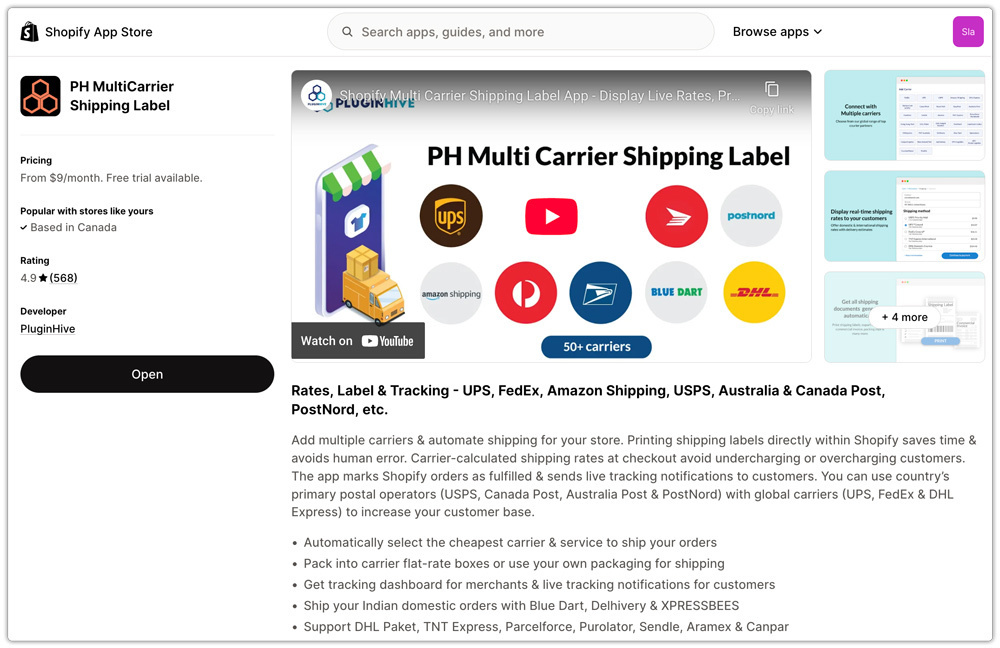
For merchants running a two-warehouse model within Shopify, the PH Multi-Carrier Shipping Label App supports fulfilment from multiple origins in a single workflow, routing US orders to the US warehouse and Canadian orders to the Canadian location, generating carrier labels from the correct origin without switching between platforms.
Problem 4: How the US Tariff on Canada Is Affecting Canadian Customers
The problem: US-based Shopify merchants shipping to Canada under a Delivered Duty Unpaid model are now exposing Canadian buyers to Canada’s September 8 retaliatory surtaxes of 15% to 50% on US-origin goods. Customers who ordered at checkout price are receiving packages with unexpected customs demands, leading to refusals, returns, and negative reviews. Canada’s surtaxes apply based on the origin of goods, not the shipping origin. A US-manufactured product shipped from a US warehouse to Canada is subject to the surtax if its HTS code is on the list.
Workarounds:
- Switch to Delivered Duty Paid (DDP) for affected product lines shipping to Canada; the merchant absorbs the duty upfront, and the customer receives the package with no surprise on delivery
- Add explicit duty disclosure at Shopify checkout for Canadian destinations to set expectations before purchase
- Use Shopify Markets to restrict shipping availability for product lines where the Canadian surtax makes fulfilment economics unworkable
- Verify the product’s origin: non-U.S.-origin goods aren’t subject to Canada’s surtax solely because they ship from a U.S. address.
Problem 5: The September 29 Import Ban Creates Immediate Compliance Risk
The problem: The September 29 import bans represent the first use of Section 338 to prohibit imports outright rather than impose tariffs. For affected categories, this is not a cost issue; it is a legal one. Products now banned from US importation from Canada:
- Motorcycles with engines over 800cc
- Packaged Canadian alcoholic beverages: beer, wine, sparkling wine, spirits (in direct-to-consumer containers)
- Dairy-adjacent products: whey protein concentrates, various forms of whey, molasses, certain non-alcoholic beer
One important nuance: bulk alcoholic shipments in containers over 4 litres (whiskies and liqueurs) were removed from the Section 338 50% tariff in the September 15 revision and are also not on the ban list; bulk product for US bottling or further processing may still be importable.
Canadian-origin products in these categories that entered the US before September 29 but have not yet entered for consumption remain subject to the 50% Section 338 tariff, not the ban; retain in-transit documentation.
Workarounds:
- Immediately halt any pending Canadian shipments of banned products destined for US importation
- Identify US-origin or non-Canadian supply alternatives for affected categories
- Sell legitimately imported inventory already in the U.S. normally; the ban applies to importation, not domestic sales.
For managing compliance documentation across a multi-SKU cross-border catalog, the Shopify international shipping guide covers origin declarations and customs documentation structure.
Conclusion
The US-Canada tariff situation has no near-term resolution in sight. Section 338 has no expiration date, Canada’s retaliatory surtaxes are explicitly dollar-for-dollar, and the escalation cycle shows no sign of unwinding. For Shopify merchants, the priority actions are: verify HTS classifications against the Section 338 annexes, recalculate landed costs with the full tariff stack, maintain USMCA certification, address Canadian customer duty transparency at checkout, reassess cross-border per-order fulfilment economics, and for merchants in banned categories, stop Canadian import shipments immediately. Treating these as a structural shift rather than a temporary disruption is the more defensible planning assumption.
FAQs
Q. Does USMCA protect my Canadian imports from Section 338?
No. Section 338 applies to covered Canadian-origin goods regardless of USMCA qualification. USMCA still exempts qualifying goods from IEEPA and Section 301 tariffs, but not the 50% Section 338 tariff.
Q. Which Canadian products are banned from US importation as of September 29?
Motorcycles above 800cc engine capacity; packaged Canadian alcoholic beverages; and dairy-adjacent products including whey protein concentrates and molasses. Bulk alcohol in containers over 4 litres is excluded from the ban and the 50% Section 338 tariff.
Q. Are Section 338 tariffs temporary?
No fixed expiration date. They stay in force until the administration issues a new proclamation modifying or revoking them. Planning for them to remain in place indefinitely is the more defensible assumption.
