


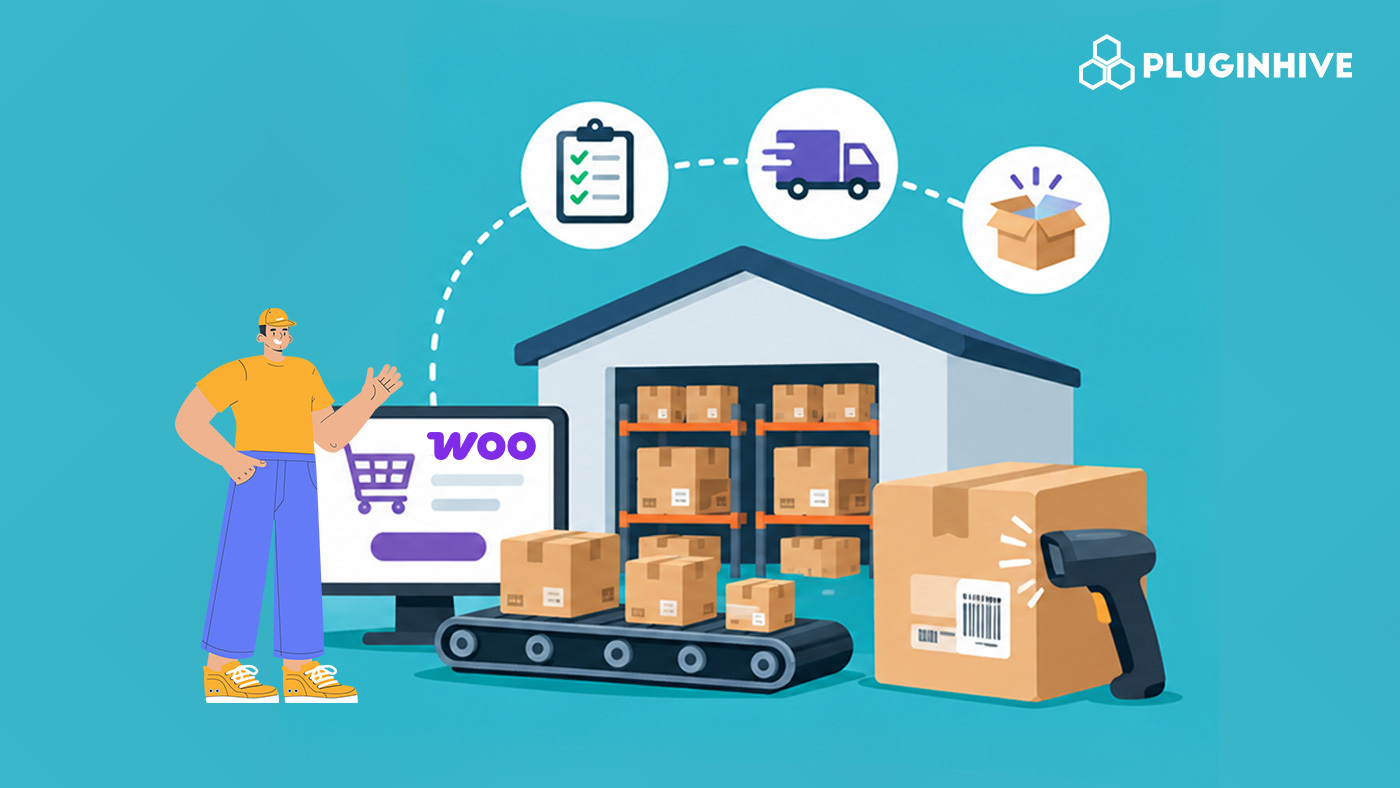
A customer clicks Buy, and somewhere between that click and a package landing on their doorstep, a whole chain of steps has to happen correctly: inventory checked, item picked, box selected, label printed, carrier collected, tracking sent. That chain is eCommerce fulfillment, and how well a store runs tends to decide whether customers come back, far more than the checkout design or the product page ever will.
This guide covers what eCommerce fulfillment actually involves, and how to keep it running smoothly whether your store runs on WooCommerce, Shopify, Magento, or BigCommerce.
On This Page
- What eCommerce Fulfillment Actually Covers
- The Stages of the eCommerce Fulfillment Process
- The Four Main eCommerce Fulfillment Models
- Where eCommerce Fulfillment Breaks Down as a Store Grows
- Tools for Managing eCommerce Fulfillment
- Conclusion
- FAQs
What eCommerce Fulfillment Actually Covers
eCommerce fulfillment is the complete process of getting a product from your inventory into your customer’s hands after an order is placed. It covers receiving and storing inventory, processing incoming orders, picking and packing items, generating shipping labels, handing shipments to a carrier, and handling returns when something comes back. Every eCommerce store runs this cycle, whether it sells ten orders a week through WooCommerce or ten thousand through Shopify.
It’s worth separating fulfillment from shipping, since the two often get used interchangeably. Shipping is one stage within fulfillment, specifically the carrier transit portion. Fulfillment is the entire operation surrounding it, including everything that happens before a package is handed over and everything that happens after it’s delivered.
The Stages of the eCommerce Fulfillment Process
- Receiving and Storing Inventory: Stock arrives from suppliers or manufacturers, gets checked against what was ordered, and is stored in a way that makes it findable later. Poor organisation at this stage compounds into slow picking times at every stage afterward.
- Order Processing: An order is placed, and payment confirmed, at which point it enters the fulfillment queue. In most eCommerce platforms, this corresponds to an order status change, Processing in WooCommerce, or an unfulfilled order in Shopify, signalling that the physical work can begin. Getting this status to update automatically later, once the order actually ships, is one of the easiest eCommerce fulfillment wins available.
- Picking and Packing: Items are retrieved from inventory and packed into appropriate packaging. Packaging choice matters more than it looks; box size directly affects dimensional weight, which directly affects what the carrier charges, so an oversized box here quietly raises cost on every order that uses it.
- Shipping Label Generation and Dispatch: In WooCommerce, Shopify, Magento, and other platforms, store owners generate a shipping label for the selected carrier and service, attach it to the package, and hand the shipment over to the carrier or schedule a pickup. As order volume grows, this process can become a manual bottleneck because teams often handle each order individually.
- Tracking and Delivery: The tracking number is attached to the order and communicated to the customer, who can follow the shipment through to delivery. Getting this step automated is one of the most effective ways to reduce “where is my order” support volume.
- Returns Processing: Returns are part of fulfillment, not a separate concern. A clear returns process, including how return labels are generated and how returned stock re-enters inventory, affects both customer trust and how quickly returned items become sellable again.
The Four Main eCommerce Fulfillment Models
| Model | How It Works | Best For |
|---|---|---|
| In-House Fulfillment | You store, pick, pack, and ship every order yourself. | Small to mid-volume stores wanting full control over packaging and process. |
| Third-Party Logistics (3PL) | An external provider stores your inventory and fulfils orders on your behalf. | Growing stores where fulfillment labour has become the bottleneck. |
| Dropshipping | A supplier ships directly to your customer; you never hold stock. | Stores testing products or operating without warehouse capacity. |
| Hybrid | Core products are handled in-house, while overflow or specific categories are handled through a 3PL. | Stores with mixed product types or seasonal volume spikes. |
There’s no universally correct eCommerce fulfillment model; the right choice depends on order volume, product type, margin structure, and how much operational control matters to the business. Many WooCommerce and Shopify stores start in-house and move to a hybrid or 3PL model once fulfillment labour starts consuming more time than it’s worth.
Where eCommerce Fulfillment Breaks Down as a Store Grows
eCommerce fulfillment processes that work comfortably at twenty orders a day tend to strain well before a hundred. The failure points are fairly predictable, and they look much the same on WooCommerce as they do on Shopify:
- Labels generated one order at a time, requiring someone to open each order individually.
- Tracking numbers copied manually into spreadsheets or emails instead of attaching to the order automatically.
- Order status not updating after dispatch, so the fulfillment queue shows orders that have already shipped.
- Shipping rates quoted at checkout that don’t match what the carrier actually bills, quietly eroding margin.
- Packaging chosen by habit rather than by fit, inflating dimensional weight across every order.
None of these are platform limitations. WooCommerce, Shopify, Magento, BigCommerce, and PrestaShop all handle real volume fine; the strain almost always comes from the manual steps layered around the platform rather than the platform itself.
Tools for Managing eCommerce Fulfillment
Most eCommerce fulfillment bottlenecks come down to three things: inaccurate shipping rates, time-consuming label generation, and tracking updates that don’t reach customers automatically. PluginHive offers carrier integrations that address these challenges across WooCommerce, Shopify, Magento, and BigCommerce.
Fulfillment Plugins for WooCommerce
- FedEx Shipping Plugin for WooCommerce with Print Label
- WooCommerce UPS Shipping Plugin with Print Label
- PH USPS Shipping Plugin for WooCommerce with Print Label
- PH Multi-Carrier Shipping Plugin for WooCommerce
- Shipment Tracking Pro for WooCommerce
Fulfillment Apps for Shopify
Fulfillment Extensions for Magento
Fulfillment Apps for BigCommerce
What Every eCommerce Store Should Prioritize, Regardless of Platform:
- Live carrier rates at checkout instead of flat-rate estimates, so customers see shipping costs based on actual carrier rates.
- Bulk label generation to process multiple orders at once instead of creating labels individually.
- Automatic tracking updates so tracking numbers are added to orders and shared with customers without manual copy-paste.
- Accurate product weights and dimensions, since shipping rates depend on having correct package and product data.
Conclusion
eCommerce fulfillment is the operational backbone of an online store, everything between the order being placed and the customer being satisfied with what arrived. The fulfillment model you choose matters, but what matters more day to day is whether the process runs without manual bottlenecks at each stage. Accurate rates, fast label generation, automatic status updates, and tracking that reaches customers on its own are what separate an eCommerce fulfillment process that scales from one that becomes the ceiling on how fast a WooCommerce or Shopify store can grow.
Need help tightening up fulfillment in your store? The PluginHive support team is here.
FAQs
Q. What is the difference between fulfillment and shipping?
Shipping is the carrier transit portion specifically, getting a package from your location to the customer. Fulfillment is the full operation around it, including inventory storage, order processing, picking, packing, label generation, tracking, and returns. Shipping is one stage inside fulfillment.
Q. What is a 3PL and when should a store consider one?
A third-party logistics provider stores your inventory and fulfils orders on your behalf. Most stores consider a 3PL once in-house fulfillment labour starts consuming more time or cost than outsourcing would, or when warehouse space becomes a genuine constraint on growth.
Q. How do I reduce the time spent generating shipping labels?
Bulk label generation is the single biggest time saver, selecting multiple orders and generating all their labels in one action rather than opening each order individually. Most PluginHive carrier plugins and apps support this across WooCommerce, Shopify, Magento, and BigCommerce.
Q. Why do my checkout shipping rates not match what the carrier charges?
Usually because the store is using flat-rate shipping, or because product weights and dimensions are missing or inaccurate. Live carrier-calculated rates, fed by accurate product data, close most of that gap since the rate shown comes directly from the carrier’s own API.
