


Stop shipment in transit on FedEx: the recall workflow most multi-carrier shipping apps don’t expose
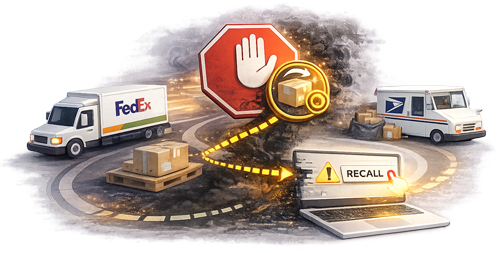
A DTC electronics brand on Shopify takes an order at 11:47 AM for two $1,200 cameras shipping to a Florida address. The order routes through the merchant’s standard fulfillment workflow — label generated, picked from the warehouse at 12:30 PM, picked up by FedEx Ground at 1:15 PM. At 2:08 PM, the brand’s fraud team flags the order: the billing address and shipping address don’t match the buyer profile pattern, the buyer’s account is 12 hours old, the payment method was a stolen card. The fraud team needs to stop the shipment.
The merchant’s order management system has no built-in stop-shipment action. The support team falls back to manual coordination: call FedEx customer service, identify the package, request a recall. The call takes 22 minutes including hold time. The FedEx agent confirms the package is currently on the truck, attempts the recall, and reports back that the package has just been transferred to the regional facility for outbound shipping — the recall window closed. The package ships overnight, delivers to the fraudulent address Wednesday morning, and the brand absorbs the $2,400 loss.
The carrier-side workflow for stop-shipment exists. FedEx supports package recalls through customer service channels and through specific API endpoints for eligible account configurations. The integration layer is where the recall either gets attempted within the window that matters or runs through a multi-step manual process that takes long enough for the package to leave the recall-eligible zone.
This article describes what stop-shipment actually requires, where the workflow consistently breaks for DTC merchants, and what the integration needs to do for in-transit recalls to fire fast enough to land.
A stop-shipment / package-recall request on a FedEx in-transit shipment is the carrier-side operation that intercepts the package before delivery and returns it to the merchant. The workflow:
For eligible FedEx account configurations, certain stop-shipment actions are exposed at the API level — programmatic recall requests through specific endpoints. For account configurations that don’t include API-level recall, the workflow runs through FedEx customer service (phone or account portal).
The recall window varies by service tier and current package location. Earlier in the route is more likely to succeed than later. Recall on overnight shipments is shorter than recall on Ground shipments because the package moves through the network faster. Same-day recalls in the buyer’s destination metro often fail because the package is already in final-mile dispatch.
Three patterns show up consistently across DTC merchants on FedEx:
1. Stop-shipment not exposed as a first-class action on the order record. The most common failure. The merchant’s order management system has no stop-shipment button or workflow on the order detail view. When the fraud team or support team identifies a need to recall an in-transit shipment, the workflow falls back to manual coordination — phone call to FedEx customer service, screen-share with operations, no audit trail of the attempt. Each recall takes 15-30 minutes of support team time. At any meaningful volume of fraud catches or address errors, the operations time becomes significant. The fix is integration-layer stop-shipment action on the order record that routes the recall request through the appropriate FedEx channel automatically.
2. Stop-shipment attempted but no API integration where eligible. A subtler failure. Some merchants have FedEx account configurations that support API-level recall requests through specific endpoints. The integration doesn’t use the API endpoint — instead routes the recall through customer service like accounts without API support. The latency on the recall increases by 10-20 minutes, which is often enough to push the package past the recall window. The fix is API-level recall request integration for eligible account configurations, with customer service routing as the fallback path.
3. Stop-shipment outcome not captured on the order record. A specific failure mode. The merchant attempts the recall and gets an outcome back from FedEx (succeeded / failed / pending). The outcome doesn’t get written back to the order record. The order shows the original “Shipped” status; the audit trail doesn’t reflect the recall attempt. Finance can’t reconcile the recall outcome against the order; the support team has to look up the recall outcome in a separate FedEx workflow when the buyer contacts about the package. The fix is recall-outcome capture on the order record with a clear status (Recall Succeeded, Recall Failed, Recall Pending) and timestamp.
These three patterns explain most of the gap between merchants who “can recall shipments” and merchants whose recall workflow fires fast enough and stays auditable end-to-end.
The workflow that doesn’t break exposes stop-shipment as a first-class action on the order record. The action triggers the recall through the API endpoint where the merchant’s account configuration supports it, falls back to customer service routing where it doesn’t. The recall outcome (succeeded, failed, pending) writes back to the order record with timestamps and attempt count. The audit trail shows every recall attempt against every shipment for finance and operations review. The support team’s per-recall coordination time drops from 22 minutes to under 2 minutes.
For high-volume DTC merchants with regular fraud-recall, address-error-recall, or customer-cancellation-recall events — electronics, luxury goods, high-AOV apparel, supplements with anti-fraud workflows — the difference between integration-layer stop-shipment and manual customer service coordination shows up directly in fraud loss prevention, in support team operations time, and in finance audit-trail completeness.
Stop-shipment in transit is one slice of the broader cancellation and recall story, alongside label voiding before pickup (BLOG-T47) and returns workflow for delivered orders (BLOG-T24). For FedEx Operations and Customer Service and the integrator partner network, stop-shipment integration is one of the cleaner workflow improvements available — the recall capability exists, API endpoints exist for eligible accounts, and the integration-layer adoption across Shopify and WooCommerce multi-carrier apps is uneven.
Happy to connect with anyone on the FedEx Operations / Customer Service product team side exploring stop-shipment workflow automation further.
This article reflects patterns observed across PluginHive’s high-volume DTC merchant base on FedEx. Stop-shipment / package-recall API endpoints, account-eligibility requirements, recall window definitions, and customer service workflow channels should be verified against current FedEx Developer (fdx) documentation and FedEx Operations guidance before commercial commitments.
PluginHive shipping solutions for FedEx integration on WooCommerce and Shopify.

Direct FedEx integration for WooCommerce — addresses the workflow gaps covered in this article.
Shopify app with native FedEx integration — addresses the workflow gaps covered in this article.
Multi-carrier label generation for Shopify across FedEx and other carriers — addresses the workflow gaps covered in this article.