


International wine shipping on FedEx: where cross-border alcohol DTC needs a fundamentally different workflow
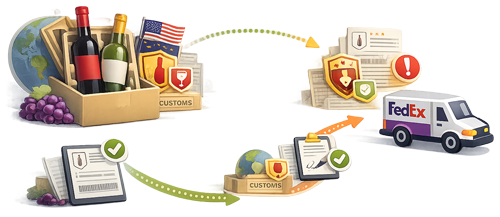
A US-based wine subscription brand ships 4,500 monthly boxes domestically — established workflow on FedEx Ground / Home Delivery, adult signature required, Saturday delivery as a checkout option, state-eligibility check at the checkout step. The brand decides to expand into the EU (specifically targeting UK and Germany based on consumer demand) and Canada. The first cross-border wine shipment goes out — an order from a UK buyer routed through what the integration treats as a standard FedEx International Priority shipment with adult signature. The shipment holds at UK customs because the import documentation doesn’t include the UK-specific alcohol declarations and the buyer isn’t registered as an alcohol importer. The merchant discovers, four days later, that the cross-border alcohol workflow is fundamentally different from the domestic workflow.
For wine clubs and DTC alcohol brands expanding cross-border, the integration that handled domestic alcohol shipping cleanly often doesn’t have the international alcohol workflow built — and merchants discover this at the first international order. The carrier-side capability exists on the FedEx side, but it requires destination-country-specific routing, alcohol-specific HS classification, country-specific licensing checks, and route-specific eligibility validation that’s substantially more complex than the domestic alcohol workflow.
This article describes what cross-border alcohol shipping actually requires, where the workflow consistently breaks for wine and DTC alcohol merchants expanding internationally, and what the integration needs to do for international wine to flow without per-shipment customs holds.
A cross-border wine shipment on FedEx involves a stack of requirements layered together:
The carrier-side workflow on FedEx’s US Specialty Delivery and International Trade Services side supports these requirements for eligible routes. The integration layer is where the cross-border alcohol workflow either gets built as a distinct path from the domestic alcohol workflow or gets attempted through a generic international workflow that doesn’t handle alcohol specifics.
Three patterns show up consistently across wine and DTC alcohol merchants expanding internationally:
1. Domestic alcohol workflow assumed to extend to international. The most common failure. The merchant’s integration handles US domestic wine shipping cleanly (adult signature, state-eligibility, Saturday delivery). When the merchant launches international DTC, the first cross-border wine order routes through a standard FedEx International service tier with the domestic alcohol flags (adult signature). The label generates; the shipment ships; destination customs holds for missing alcohol-specific documentation or for buyer-licensing reasons. The fix is destination-aware alcohol routing — international addresses route through an international-alcohol-specific workflow distinct from the domestic alcohol workflow.
2. Cross-border alcohol eligibility not validated at checkout. A subtler failure. Some integrations attempt international alcohol shipping but don’t check destination-country alcohol-import eligibility at the checkout step. Buyers in countries where DTC alcohol imports are prohibited (or restricted to specific licensed importers) complete checkout for wine orders that can’t legally ship. The merchant either has to refund and explain, or the shipment ships and gets seized/refused at customs. The fix is destination-country alcohol-eligibility check at the rate-quote step, with messaging to the buyer if the route doesn’t support DTC alcohol import.
3. HS code on the manifest doesn’t match alcohol-specific classification. A specific failure mode. Some integrations use generic HS codes for cross-border shipments without alcohol-specific differentiation. Wine shipments cross customs with codes that classify the goods as something else (general beverages, gift items); destination customs flags the mismatch; the shipment holds for reclassification with the alcohol excise duty re-calculated. The fix is alcohol-specific HS classification routing — wine SKUs carry HS codes specific to still / sparkling / fortified wine subcategories, with country-specific extensions for destinations that require them.
These three patterns explain most of the gap between domestic alcohol DTC and successful cross-border alcohol expansion.
The workflow that doesn’t break treats cross-border alcohol as a distinct workflow path. Destination country alcohol-import eligibility is validated at checkout. Buyers in countries that allow DTC personal-import alcohol see the option; buyers in restricted destinations see appropriate messaging. The international service tier routes through FedEx-supported alcohol-eligible international lanes. The commercial invoice carries alcohol-specific HS codes with ABV / volume / origin declarations. Adult signature is configured for international destinations where applicable (international adult-signature requirements vary by country and aren’t always the US 21+ standard).
For wine and alcohol DTC merchants expanding internationally — typically starting with UK / EU / Canada / Australia and expanding from there — the integration-layer support for cross-border alcohol is the difference between recurring international customs friction and clean cross-border expansion that doesn’t undermine the domestic workflow’s operational efficiency.
Cross-border alcohol is one slice of the broader specialty cross-border story. Adjacent topics include cold-chain dry ice shipping internationally (extending T15 domestic to international flows), pharmaceutical cross-border (different regulatory regime — adjacent to BLOG-T61 First Overnight pharma), and hazmat cross-border for regulated cargo categories generally.
For FedEx US Specialty Delivery, International Trade Services, and the Alcohol Shipping team, cross-border alcohol workflow is one of the more complex specialty-cross-border conversations — the carrier-side capability varies meaningfully by route, the country-specific regulatory landscape evolves regularly, and the integration-layer adoption across multi-carrier shipping apps for cross-border alcohol is uneven.
Cross-border alcohol workflow automation still feels like one of the under-built capability areas across Shopify and WooCommerce shipping infrastructure for wine and DTC alcohol brands expanding internationally.
Happy to connect with anyone on the FedEx US Specialty Delivery / International Trade Services / Alcohol Shipping side exploring cross-border alcohol workflow further.
This article reflects patterns observed across PluginHive’s wine and DTC alcohol merchant base on FedEx. **Cross-border alcohol shipping eligibility, country-specific licensing and import-quantity requirements, FedEx-supported international wine routes, alcohol-specific HS classification, and adult-signature international variations should be verified against current FedEx Developer (fdx), US Specialty Delivery, International Trade Services, and applicable destination-country regulatory documentation before commercial commitments.** The cross-border alcohol regulatory landscape evolves regularly.
PluginHive shipping solutions for FedEx integration on WooCommerce and Shopify.

Direct FedEx integration for WooCommerce — addresses the workflow gaps covered in this article.
Shopify app with native FedEx integration — addresses the workflow gaps covered in this article.
Multi-carrier label generation for Shopify across FedEx and other carriers — addresses the workflow gaps covered in this article.