


What “Fragile” actually means in FedEx’s network: the gap between sticker expectations and operational handling
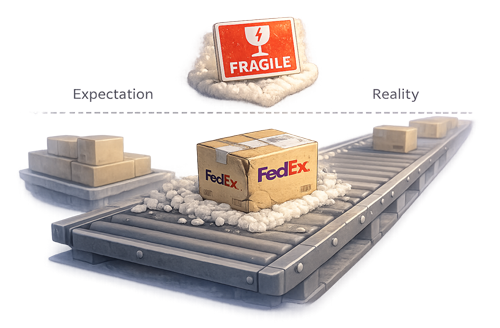
A DTC ceramics brand ships handmade pottery in carefully padded boxes. Each box gets a large “FRAGILE” sticker applied at the fulfillment desk. The merchant’s operations lead briefs the team that fragile stickers ensure careful handling. The orders ship; packages move through FedEx’s network at the same speed as every other rectangular box on the automated sortation belt; ~3% arrive damaged anyway. The merchant files claims; FedEx pays out the default $100 declared value cap on each; the actual product values were $180–$340. The merchant absorbs the difference and revisits the fragile-handling assumption.
The “FRAGILE” sticker is one of the most consistently misunderstood signals in eCommerce shipping. Merchants apply it expecting different handling from the carrier; the operational reality at the sortation hub is that automated belts don’t slow down for visual cues. Carrier network handling at scale is determined by the data on the manifest, not by stickers on the outside of the box.
This article describes what actually changes handling in FedEx’s network, where the workflow consistently breaks for merchants in damage-prone categories, and what the integration layer needs to do to set correct expectations and route the right configuration.
FedEx moves hundreds of millions of packages per year through a largely automated sortation network. Manual handling exists at specific points — induction, exception handling, hazmat routing, certain last-mile situations — but the bulk of the journey assumes packaging itself is the protection. Signals that actually change handling come from the manifest, not from the box exterior:
Declared value above defined thresholds. When the merchant declares a value above the standard cap, FedEx’s network routes the package through higher-touch handling and extends claim coverage commensurate with the declared amount. Without the declaration, the default $100 liability cap applies regardless of actual product value or fragile stickers.
Adult Signature Required / Direct Signature Required. Packages with signature requirements route to driver-handoff at delivery rather than doorstep drop-off. The handoff itself creates a touchpoint where damage is more likely to be noticed and documented at receipt, reducing post-delivery damage attribution disputes.
Hazmat / Dangerous Goods declarations. Regulated cargo with proper manifest declarations routes through specialized handling tracks separate from the general sortation flow. This isn’t “fragile” handling per se, but it’s the closest equivalent in the automated network — packages move through different physical paths.
Specific service tiers. FedEx Specialty Delivery options (Date Certain, Appointment Delivery, certain Express tiers) route packages through different network segments. Some Specialty options provide handling profiles that differ meaningfully from standard Ground or Home Delivery.
Package weight, dimensions, and packaging quality. The most important factor. A well-packed box with appropriate internal protection, dimensional buffer around the product, and rigid outer construction survives the automated network regardless of stickers. A poorly packed box with the product loose inside doesn’t, regardless of how many fragile stickers are applied.
Three patterns show up consistently across merchants in damage-prone categories:
1. Fragile sticker applied without declared value matching product cost. The most common failure. The merchant relies on the sticker for both handling expectation and claim coverage. The default $100 declared value cap applies; products worth $300+ ship without the value declaration that would extend coverage. When damage happens, the claim pays $100; the merchant absorbs the rest and assumes the carrier mishandled the package — when the underlying gap was a manifest-side declaration. The fix is integration-layer logic that prompts declared value when product value exceeds a threshold, and writes the value to the FedEx manifest at label generation.
2. Signature flag absent on high-value or fragile shipments. A related failure. Packages worth more than $300, or in damage-prone categories, ship without Adult Signature or Direct Signature requirements. The driver leaves them at the doorstep; the buyer isn’t there to inspect on arrival; damage discovered later becomes a “happened in transit” claim with no contemporaneous documentation. The fix is signature-requirement logic tied to product flags (category, declared value, fragility) at the shipment-builder step.
3. Integration “fragile” checkbox that doesn’t route configuration changes. A subtler failure. Some integrations expose a “fragile” toggle in the order screen that the operations team can check. The checkbox prints a fragile sticker on the label and may flag the order in the merchant’s WMS — but it doesn’t route to declared value, signature, or service-tier configuration changes on the FedEx manifest. The merchant believes fragile handling is being requested; the carrier sees a standard package with a sticker. The fix is fragile-flag-to-manifest-configuration logic — checking “fragile” cascades to declared value, signature, and (where applicable) service-tier adjustments.
These three patterns explain most of the operational gap between merchants who “ship fragile categories” and merchants whose configuration actually matches the protection they need.
The workflow that doesn’t break treats damage-prone product categories as configuration patterns rather than sticker decisions. SKUs in fragile categories carry metadata at the product level — declared value reference (typically actual product cost), signature requirement (Adult or Direct), service-tier preference where applicable. The shipment builder reads these at order capture and writes the appropriate configuration to the FedEx manifest at label generation. Stickers can still be applied for buyer-facing brand signaling; the actual protection comes from the manifest configuration.
For merchants in damage-prone categories — ceramics, glassware, certain electronics, art and prints, fine jewelry, audio equipment, premium kitchenware — the difference between integration-layer configuration handling and sticker-based expectation shows up directly in claim payouts when damage occurs and in the post-damage customer-service experience.
Fragile handling is one slice of the broader manifest-configuration story for high-value or damage-prone shipments. The full picture includes declared value handling (BLOG-T25), signature requirement workflows (BLOG-T48), service-tier routing for premium categories (BLOG-T13 Date Certain / Appointment), and specialty handling for regulated cargo (BLOG-T15 cold-chain, BLOG-T49 hazmat). Each is an integration-layer area where the carrier-side capability supports more than most multi-carrier shipping apps expose at the order-capture step.
For FedEx Operations and the Customer Experience team, this is one of the workflow areas where setting correct merchant expectations matters as much as enabling the configuration. The fragile-sticker assumption is widespread; correcting it requires both integration-layer support for the right configuration and merchant education on what actually drives handling in the network.
Fragile-handling expectation workflow automation still feels like one of the under-built capability areas across Shopify and WooCommerce shipping infrastructure for damage-prone product categories.
Happy to connect with anyone on the FedEx Operations / Customer Experience side exploring fragile-handling expectation workflow further.
This article reflects patterns observed across PluginHive’s merchant base in damage-prone product categories on FedEx. FedEx network handling specifics, declared value cap policies, signature requirement options, and Specialty Delivery handling profiles should be verified against current FedEx Developer (fdx) documentation before commercial commitments.
PluginHive shipping solutions for FedEx integration on WooCommerce and Shopify.

Direct FedEx integration for WooCommerce — addresses the workflow gaps covered in this article.
Shopify app with native FedEx integration — addresses the workflow gaps covered in this article.
Multi-carrier label generation for Shopify across FedEx and other carriers — addresses the workflow gaps covered in this article.