


Dangerous Goods multi-SKU stacking on FedEx: where two Limited-Quantity-eligible items combine into a full-hazmat shipment
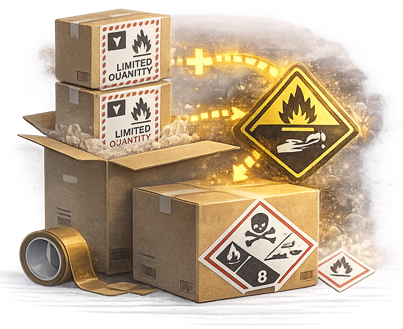
A DTC beauty brand on Shopify launches a “Travel Trio” bundle: a 4 oz dry shampoo aerosol, a 3 oz deodorant spray aerosol, and a 5 oz hairspray aerosol shipped together as a single SKU bundle. Each individual aerosol within the bundle is well within the Limited Quantity per-package inner-quantity threshold (typical aerosol LQ limit is 1 L net contents per inner package; each item in the bundle is under 200 mL). The brand’s integration handles aerosol hazmat at the SKU level with LQ marking on the label per BLOG-T49’s workflow.
The bundle ships normally for the first two months — about 1,800 bundles move through with LQ marking and no exceptions. In month three, the brand starts seeing rejection-returns on the bundle SKU specifically. The FedEx exception note reads “Hazardous material quantity exceeds Limited Quantity threshold — full DG documentation required.” The brand’s operations team digs in and finds the issue: the per-class aggregate hazmat quantity across the three aerosols in the bundle exceeds the LQ per-package threshold even though each individual item is below the per-inner-package limit. The bundle requires full FedEx Dangerous Goods documentation — shipping papers, emergency response info, trained-shipper certification — not the simplified LQ workflow.
The carrier-side workflow handles this exactly as DOT regulations require. LQ thresholds apply at the package level across aggregated inner-packaging hazmat quantities, not on the per-SKU basis. The integration layer is where the multi-SKU quantity stack either gets calculated at the label step and routes to the appropriate compliance tier, or stays per-SKU-only and creates regulatory exposure on the bundle / multi-SKU order segment.
This article describes what DG multi-SKU stacking actually requires, where the workflow consistently breaks for DTC merchants with bundle / multi-SKU patterns, and what the integration needs to do for compliance to flow per-order rather than per-SKU.
DOT Limited Quantity thresholds apply at the package level — the total aggregate hazmat quantity across all hazmat items in a single shipment package determines LQ eligibility. The relevant per-package limits:
A bundle SKU or a multi-SKU order combines hazmat from multiple inner packagings into a single outer carton. The aggregate quantities sum across all hazmat-classified items in the order. When the aggregate exceeds the LQ per-package threshold (or the per-class aggregate cap), the shipment doesn’t qualify for LQ and requires full FedEx Dangerous Goods documentation:
For DTC merchants with multi-hazmat-SKU order patterns — beauty brands with bundle SKUs, brands selling aerosols + flammable liquids together, brands with subscription boxes containing multiple hazmat items — the difference between LQ and full DG matters at every order.
Three patterns show up consistently across DTC merchants with multi-hazmat-SKU patterns:
1. Multi-SKU quantity not calculated; LQ applied per-SKU. The most common failure. The integration handles hazmat at the per-SKU level — each SKU gets LQ classification based on its own inner-packaging quantity. Multi-SKU orders ship under LQ even when the aggregate exceeds the threshold. Rejection-returns happen at FedEx sortation when the aggregate gets caught. The fix is order-level multi-SKU quantity stack calculation at the label step.
2. Multi-SKU calculation present but full DG workflow not integrated. A subtler failure mode. Some merchants calculate the stack and detect the LQ-to-DG escalation case but don’t have full DG workflow integration — no shipping paper generation, no trained-shipper certification storage, no DG service routing. Orders that need full DG ship under LQ anyway or get blocked at checkout. The fix is full DG workflow integration through the FedEx Ship API DG endpoints with shipping paper generation and DG service routing.
3. DG workflow present but trained-shipper certification expired or missing. A specific failure mode. The merchant has DG workflow with shipping paper generation, but the trained-shipper certification on file has expired (typical cycle is 36 months for DOT recurrent training) or was never on file. FedEx rejects DG manifests without current certification. The fix is trained-shipper certification tracking with expiration alerts (typically 60-90 days before).
These three patterns explain most of the DG compliance exposure across the multi-hazmat-SKU DTC merchant base.
The workflow that doesn’t break calculates the multi-SKU hazmat quantity stack at the label step — summing per-class aggregates across all hazmat-classified items in the order against the LQ per-package thresholds. Orders within the threshold ship under LQ workflow with LQ marking and Ground routing. Orders that exceed the threshold escalate to full FedEx Dangerous Goods workflow — shipping papers generated through the FedEx Ship API DG endpoints, trained-shipper signature applied (certification verified as current), DG-specific service routing, full hazmat markings on the label. The classification decision (LQ / DG) writes to the order record for audit-trail purposes.
For DTC categories with multi-hazmat-SKU order patterns — beauty brands with bundle SKUs, fragrance brands selling alongside other hazmat cosmetics, subscription-box brands with multi-item hazmat shipments — the difference between integration-layer DG stacking workflow and per-SKU-only LQ flow shows up directly in rejection-return rates on multi-SKU orders, in DOT regulatory compliance posture, and in operations time on the hazmat segment.
DG multi-SKU stacking is the natural extension of the LQ workflow (BLOG-T49) for higher-quantity hazmat orders. The full picture also includes lithium battery shipping (Class 9 with its own DG workflow) and international hazmat shipping (country-specific destination DG rules layered on top of US-origin DOT). For FedEx Dangerous Goods and the integrator partner network, multi-SKU DG stacking is one of the cleaner workflow improvements available — the regulatory framework is well-established, the FedEx DG service options exist, and the integration-layer adoption across Shopify and WooCommerce multi-carrier shipping apps is uneven.
Happy to connect with anyone on the FedEx Dangerous Goods product team side exploring multi-SKU hazmat stacking workflow automation further.
This article reflects patterns observed across PluginHive’s DTC merchant base shipping multi-hazmat-SKU orders on FedEx. DOT Limited Quantity per-package thresholds, per-class inner-quantity caps, full Dangerous Goods documentation requirements, trained-shipper certification cycles, and FedEx Ship API DG endpoint integration patterns should be verified against current DOT 49 CFR Subchapter C guidance and FedEx Dangerous Goods product documentation before commercial commitments.
PluginHive shipping solutions for FedEx integration on WooCommerce and Shopify.

Direct FedEx integration for WooCommerce — addresses the workflow gaps covered in this article.
Shopify app with native FedEx integration — addresses the workflow gaps covered in this article.
Multi-carrier label generation for Shopify across FedEx and other carriers — addresses the workflow gaps covered in this article.