


International return labels on FedEx for cross-border DTC: where the domestic returns playbook stops working
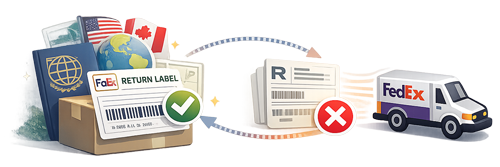
A US-based DTC apparel brand on Shopify launches international sales into the EU mid-year. Outbound shipping integrates cleanly — FedEx International Priority for B2C orders, customs identifiers handled at checkout, ETD for paperless documentation. The first EU buyer requests a return three weeks after launch. The merchant’s support team uses the existing returns workflow — the same one that handles domestic returns with email-delivered FedEx return labels generated through the Ship API. The label generates but with the wrong service tier; the German buyer can’t drop it at a US-domestic FedEx location; the label format doesn’t match what the destination FedEx network expects.
The support team falls back to manual coordination — contacting FedEx in Germany, generating a local return label through fedex.com, walking the buyer through an unfamiliar process. The buyer waits four days for a return label that should have been in their inbox in minutes. The merchant’s operations efficiency on domestic returns doesn’t carry over to international, and the gap is visible on every cross-border return request.
The carrier-side capability for international returns is well-supported through FedEx International Trade Services. The integration layer is where most multi-carrier shipping apps either don’t handle international returns at all or handle them as a degraded version of the domestic flow.
This article describes what international returns actually require, where the workflow consistently breaks for cross-border DTC, and what production-grade international returns automation looks like.
A return shipment from an international buyer back to the merchant’s domestic warehouse is fundamentally a cross-border international shipment in reverse. The workflow needs:
The FedEx International Trade Services product portfolio supports international returns through dedicated return-service-tier options and documentation workflows. Different destination countries have different drop-off network density (broader in major EU markets, narrower in some APAC and LAC markets).
Three patterns show up consistently across cross-border DTC merchants:
1. International returns attempted through domestic workflow. The most common failure. The merchant’s integration handles domestic returns cleanly via the FedEx Ship API return-label endpoint with email-delivered labels (covered in BLOG-T24). When a cross-border return request arrives, the integration runs the same workflow — generates a Ground / Home Delivery return label that doesn’t validate against an international address. The label either fails at generation or generates but doesn’t work at the destination FedEx network. The fix is destination-aware return-label routing — international addresses route to international service tiers.
2. International return label generated but customs documentation missing. A subtler failure. Some integrations generate international return labels with the right service tier but skip the reverse customs documentation (commercial invoice, HS codes, IOR routing). The label gets to the buyer; the buyer drops the return at a FedEx location; the shipment ships back but gets held at the merchant’s country customs because the reverse documentation is missing. The merchant has to coordinate broker clearance for an inbound return. The fix is comprehensive international return-flow handling that includes the reverse commercial invoice and customs identifier routing.
3. Country-specific drop-off network not exposed to the buyer. A specific failure mode. The merchant generates the international return label correctly with proper documentation, but the buyer doesn’t know where to drop it. The label arrives with no information about FedEx drop-off locations near the buyer’s address — the buyer has to research fedex.com or contact local FedEx for guidance. Friction adds days to the return cycle. The fix is country-specific drop-off location display in the return-label delivery email, with nearby locations shown to the buyer in their geography.
These three patterns explain most of the gap between cross-border DTC merchants who “have international returns figured out” and merchants whose returns workflow actually flexes between domestic and international per-shipment.
The workflow that doesn’t break detects international destinations at the return-request step and routes through the international returns path automatically. International service tier selected (FedEx International Priority Returns or equivalent). Reverse commercial invoice generated from order data with appropriate HS codes and customs identifiers. Return label delivered to the buyer via email through the FedEx Ship API, with country-specific drop-off locations near the buyer shown inline. Return tracking flows back to the order record across international network segments.
For cross-border DTC merchants with meaningful international return volume — apparel and footwear especially, given category return rates — the difference between integration-layer international returns automation and degraded-domestic-workflow handling shows up directly in return cycle time, in support team coordination effort per international return, and in buyer-experience metrics on the international segment.
International returns are one slice of the broader returns workflow story. The full picture also includes domestic email-delivered return labels (BLOG-T24), pre-printed vs on-demand returns strategy for apparel (BLOG-T59), and adjacent cross-border customs handling (BLOG-T01 EU identifiers, BLOG-T52 Brazil CPF/CNPJ, BLOG-19 India CSB). Each is an integration-layer area where the carrier-side capability supports more than most multi-carrier shipping apps expose.
For FedEx International Trade Services and the Returns product team, international returns workflow automation is one of the cleaner integration-layer improvements available — the carrier-side capability for international return service tiers exists, and the integration-layer adoption across multi-carrier shipping apps is uneven.
International returns workflow automation still feels like one of the under-built capability areas across Shopify and WooCommerce shipping infrastructure for cross-border DTC.
Happy to connect with anyone on the FedEx International Trade Services / Returns product side exploring international returns workflow automation further.
This article reflects patterns observed across PluginHive’s cross-border DTC merchant base on FedEx. International return service tiers, reverse customs documentation requirements, country-specific drop-off networks, and FedEx Track API international event structures should be verified against current FedEx Developer (fdx) documentation before commercial commitments.
PluginHive shipping solutions for FedEx integration on WooCommerce and Shopify.

Direct FedEx integration for WooCommerce — addresses the workflow gaps covered in this article.
Shopify app with native FedEx integration — addresses the workflow gaps covered in this article.
Multi-carrier label generation for Shopify across FedEx and other carriers — addresses the workflow gaps covered in this article.