


HS code validation on FedEx international: where customs holds trace back to the product catalog
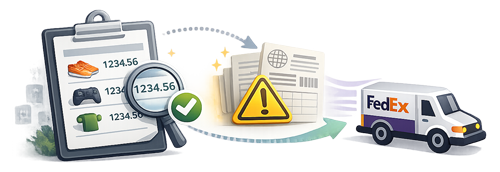
A DTC apparel brand ships a $94 women’s wear order from Seattle to a buyer in the EU. The order routes FedEx International Priority with a commercial invoice. The shipment reaches destination customs Wednesday morning. The customs broker flags the HS code on the invoice — `6109.10.00.10` — as not matching the product description (“knit-cotton blouse, women’s”). The actual product is a woven-cotton blouse; the correct HS code starts with `6206` rather than `6109` (the difference between knit and woven garments). The shipment sits at customs while the broker requests reclassification documentation; the merchant’s support team coordinates; resubmission happens Thursday afternoon; the package finally clears Friday.
The buyer waits four days for an order that would have cleared cleanly with the right code on the invoice. The merchant’s support team spent operations time on a per-shipment recovery that should have been a per-SKU classification at product setup. The carrier-side data on HS classifications is well-supported through FedEx International Trade Services and broker partner networks. The integration layer is where the HS code on the manifest either gets validated at product setup, validated again at label generation, or just trusts whatever was entered at SKU creation.
This article describes what HS code validation actually requires, where the workflow consistently breaks for cross-border DTC, and what the integration needs to do for international shipments to clear customs without classification holds.
The Harmonized System (HS) is the international product classification framework administered by the World Customs Organization (WCO). Every internationally traded product gets an HS code — typically 6 digits at the international level, extended to 8–10 digits at the country level for tariff and statistical purposes.
The code on a FedEx international commercial invoice serves several functions:
For HS code validation to work cleanly, the code on the manifest needs to:
The carrier-side support for validation exists through FedEx International Trade Services, partner customs brokers, and commercial HS classification services that validate codes against current tariff schedules per destination country.
Three patterns show up consistently across cross-border DTC merchants:
1. HS code entered at product setup without classification training. The most common failure. The merchant’s operations team enters an HS code at SKU setup — often the first code that came up in a Google search, or copied from a similar product, or selected from a too-generic category. The code looks plausible at 6 digits but doesn’t match the actual product attributes (knit vs woven, men’s vs women’s, composition percentages, intended use). Shipments using the code clear customs sometimes (when the broker is lenient or the customs officer doesn’t catch the mismatch) and hold sometimes (when the mismatch appears during review). The pattern is unpredictable and traces back to the catalog. The fix is HS code validation at product setup with a classification service that flags codes inconsistent with product descriptions.
2. HS code valid at international level but missing country-specific extension. A subtler failure. The merchant’s catalog has 6-digit HS codes — valid at the international level but not at the country-specific extended level (typically 8 or 10 digits) that some destination countries require for clearance. Shipments to countries with relaxed enforcement clear; shipments to countries with strict customs (Brazil, India, EU) hold for the additional digit precision. The fix is country-specific HS code extension at the manifest step — the integration knows the destination country and extends the 6-digit code to the appropriate length using current tariff data.
3. HS code never re-validated against current tariff schedules. A specific failure mode. The merchant’s catalog HS codes were entered 18 months ago. The destination country’s tariff schedule has updated since then — codes have been added, retired, or reclassified. Shipments now ship with codes that no longer exist (retired) or have been replaced by different codes for the same product category. Customs holds at the destination because the code on the manifest doesn’t match the current schedule. The fix is periodic re-validation against current tariff data (typically quarterly or annually, depending on category volatility).
These three patterns explain most of the recurring customs-hold tickets that DTC merchants attribute to “broker issues” or “destination customs being slow.”
The workflow that doesn’t break treats HS code as a first-class product attribute, validated at product setup against current tariff schedules and re-validated periodically. At label generation, the integration confirms the code against the destination country’s current tariff schedule, extends the code to the country-specific length where required, and writes the validated code to the commercial invoice and the FedEx manifest. The merchant’s support team intervenes only on exceptions (uncommon-category products, regulatory-flagged shipments) rather than on routine classifications.
For cross-border DTC merchants with meaningful international volume — apparel, electronics, beauty, supplements, all categories with material-composition or feature-driven HS classification — the difference between integration-layer HS validation and catalog-trust-only flow shows up directly in customs-hold frequency, in the support team’s per-shipment international workflow time, and in the broker’s per-shipment reclassification activity.
HS code validation is one slice of the broader cross-border customs workflow story. The full picture includes destination customs identifier handling (EU EORI / IOSS — BLOG-T01, Brazil CPF / CNPJ — BLOG-T52, India CSB IV/V — BLOG-19), ETD documentation flow (BLOG-T04), DDP / Importer of Record election (BLOG-T06), and the broader manual-customs-paperwork cost story (BLOG-T05). Each is an integration-layer area where the carrier-side capability supports more than most multi-carrier shipping apps expose at the catalog or label-generation step.
For FedEx International Trade Services and the integrator partner network, HS code validation is one of the cleaner workflow improvements available — the classification data exists, the integration-layer fix is at the product catalog rather than per shipment, and the impact on customs-hold frequency is meaningful for any production-volume cross-border DTC merchant.
HS classification workflow automation still feels like one of the under-built capability areas across Shopify and WooCommerce shipping infrastructure for cross-border DTC.
Happy to connect with anyone on the FedEx International Trade Services side exploring HS classification workflow automation further.
This article reflects patterns observed across PluginHive’s cross-border DTC merchant base on FedEx. HS classification rules, WCO Harmonized System schedule updates, country-specific tariff extensions, and FedEx commercial invoice handling should be verified against current FedEx International Trade Services documentation and applicable customs authority guidance before commercial commitments.
PluginHive shipping solutions for FedEx integration on WooCommerce and Shopify.

Direct FedEx integration for WooCommerce — addresses the workflow gaps covered in this article.
Shopify app with native FedEx integration — addresses the workflow gaps covered in this article.
Multi-carrier label generation for Shopify across FedEx and other carriers — addresses the workflow gaps covered in this article.