



Magento gives you full control over your ecommerce site, but it also demands a lot from your hosting environment. If you’re using a generic host or shared server, you might be facing crashes, slow load times, or compatibility issues.
On the other hand, choosing a Magento-optimized hosting plan from an experienced provider can dramatically improve your store’s speed, reliability, and scalability.
Let’s look at the best Magento hosting options for 2025-2026. We’ll explore Magento-specific hosting features and answer the most common questions store owners ask when comparing plans.
Article Contains
- Magento hosting vs. Generic hosting
- Specific features of Magento hosting
- Factors to consider when selecting Magento hosting
- Best Magento Hosting Providers
- Conclusion
- FAQs
Magento hosting vs. Generic hosting
Magento’s architecture is more complex and resource-intensive than most CMS platforms. Generic hosting plans usually aren’t equipped to handle it, especially at scale.
Magento hosting is optimized for Magento-specific performance, with considerations like:
- Server resources tuned for Magento’s high memory and CPU requirements
- Pre-configured caching stacks like Redis and Varnish
- Security rules tailored to Magento’s file system and ecommerce data handling
Generic hosting lacks the necessary stack and support out of the box. That means:
- You’ll likely see slow load times and frequent compatibility issues.
- Most providers don’t offer Magento-certified support or performance guidance.
- Upgrades and patches often have to be manually configured, which can undermine the benefits associated with the fastest Magento hosting platforms.
Specific features of Magento hosting
How does Magento hosting do all of that? Specially configured hosting plans include optimizations and settings that align with how the platform handles caching, search, security, and development workflows.
- Performance optimization
Magento hosting environments come pre-configured with tools like full-page caching, Redis, and Varnish to handle dynamic content efficiently. These features drastically reduce server load and page load times, which is especially important for stores with large product catalogs and high traffic.
In contrast, generic hosting typically relies on basic PHP caching or no caching at all, leading to slower performance and poor scalability.
- Magento-specific support
Hosting providers that specialize in Magento usually staff their support teams with Magento-certified developers or engineers familiar with the platform’s quirks. This means faster troubleshooting when issues arise with extensions, updates, or site crashes.
Generic hosting providers usually offer generalized support that may not understand Magento’s structure, causing delays and frustration during critical store issues.
- Security and compliance
Magento hosting should include PCI-compliant environments, web application firewalls (WAFs), and DDoS protection out of the box. These features are configured specifically to protect sensitive ecommerce data and prevent attacks targeting Magento’s known vulnerabilities.
Generic hosting may offer basic security features, but it typically lacks the e-commerce specific protections required for a secure Magento store.
- Developer and store management tools
Magento-optimized hosting plans usually include one-click staging environments, version control, and deployment tools built into the dashboard. These tools make it easy for store owners and developers to test changes without affecting the live site, reducing the risk of downtime or broken features.
Generic hosts often don’t provide staging environments or dev tools unless you configure them manually, which can be time-consuming and error-prone.
Factors to consider when selecting Magento hosting
Choosing the right Magento hosting provider requires more than just checking the price. You’ll want to match your store’s technical and business requirements with a hosting environment that can support them today and in the future.
A. Performance and traffic expectations
Start by estimating how many visitors your store handles during peak periods, and how that might grow. Magento stores with high traffic or large catalogs require more RAM, CPU, and advanced caching to maintain fast load times.
Then, look for providers that offer dedicated or scalable cloud resources with proven benchmarks for Magento performance.
B. Budget and pricing structure
While it’s tempting to go with the cheapest plan, underpowered hosting can end up costing more in lost revenue and downtime.
Determine your monthly hosting budget and weigh it against the cost of support, performance tools, and PCI compliance (some providers bundle these, others charge extra). Choose a provider with transparent pricing and upgrade paths as your store grows.
C. Support and managed services
If you don’t have a developer on staff, fully managed hosting can save you time (and headaches) and prevent costly mistakes. Managed Magento hosts handle updates, server tuning, backups, and security for you.
Ask about support availability (24/7 chat, phone, ticketing), Magento expertise, and response times before committing.
D. Infrastructure type (cloud, VPS, dedicated)
Magento runs best on environments where resources aren’t shared or throttled. VPS and cloud plans offer a flexible middle ground, while dedicated servers provide maximum performance for large stores.
Choose an infrastructure type based on your current resource usage, expected growth, and technical expertise.
E. Security capabilities and compliance standards
Ecommerce stores have to meet higher security standards, especially if you’re handling credit card payments directly.
Look for PCI-compliant hosting, WAFs, daily backups, malware scanning, and DDoS protection. Ask how the provider handles patching and whether security features are included or add-ons.
F. Ease of use and management interfaces
A good hosting dashboard can simplify everything from staging and backups to email management and DNS updates. If you’re not technical, look for a provider that offers a user-friendly control panel and one-click tools for Magento installs. Advanced users may prefer full root access and SSH control, but even they benefit from a clean interface that saves time.
Best Magento Hosting Providers
1. Liquid Web

Liquid Web’s Magento hosting options are top-tier, offering fully managed cloud servers built specifically for the platform. Their hosting environment is optimized for speed, security, and scalability, with no shared resources to slow you down.
What sets Liquid Web apart is its Magento expertise: support staff are certified and available 24/7 to help with performance tuning, extensions, and store optimization. You’ll also get pre-configured caching, PCI compliance tools, and automatic backups, making it an enterprise-grade solution accessible to every ecommerce business.
Features:
- Fully managed servers optimized for Magento
- Auto-scaling and built-in CDN
- Caching stack with Varnish, Redis, and Elasticsearch
- PCI-compliant infrastructure with proactive security
- 24/7/365 Magento-certified support
Best for: Mid-size to enterprise stores with high traffic or complex setups
Starting at: $59/month
Liquid Web also offers a wide range of VPS and dedicated bare metal servers that can be used for Magento hosting, if you’re comfortable with server management.
2. Atlantic.Net
Atlantic.Net is one of the most experienced hosting companies on the planet, offering cloud hosting that delivers a dependable, performance‑focused platform for Magento workloads that need flexibility without shared hosting constraints. Built on enterprise-grade infrastructure, Atlantic.Net cloud servers offer dedicated resources, fast deployment, and consistent performance designed to support growing online stores.
Instead of locking customers into rigid service bundles, Atlantic.Net emphasizes control and scalability. Cloud servers can be provisioned in seconds, scaled vertically as demand increases, and customized to match your operating system and workload requirements. With transparent pricing and U.S.-based support available around the clock, the platform is well‑suited for businesses that want reliable cloud infrastructure without unnecessary complexity.
Features:
- Dedicated cloud VPS resources
- SSD‑based storage for fast performance
- Flexible hourly or monthly billing
- Linux and Windows server options
- 24/7/365 U.S.‑based technical support
Best for: Growing Magento and ecommerce sites that need predictable cloud performance and infrastructure flexibility
Starting at: $10/month for entry‑level cloud VPS plans. For larger or more specialized deployments, Atlantic.Net also offers higher‑capacity cloud tiers, compliance‑ready configurations, and dedicated bare metal servers that can accommodate advanced performance, security, or regulatory requirements.
3. Cloudways
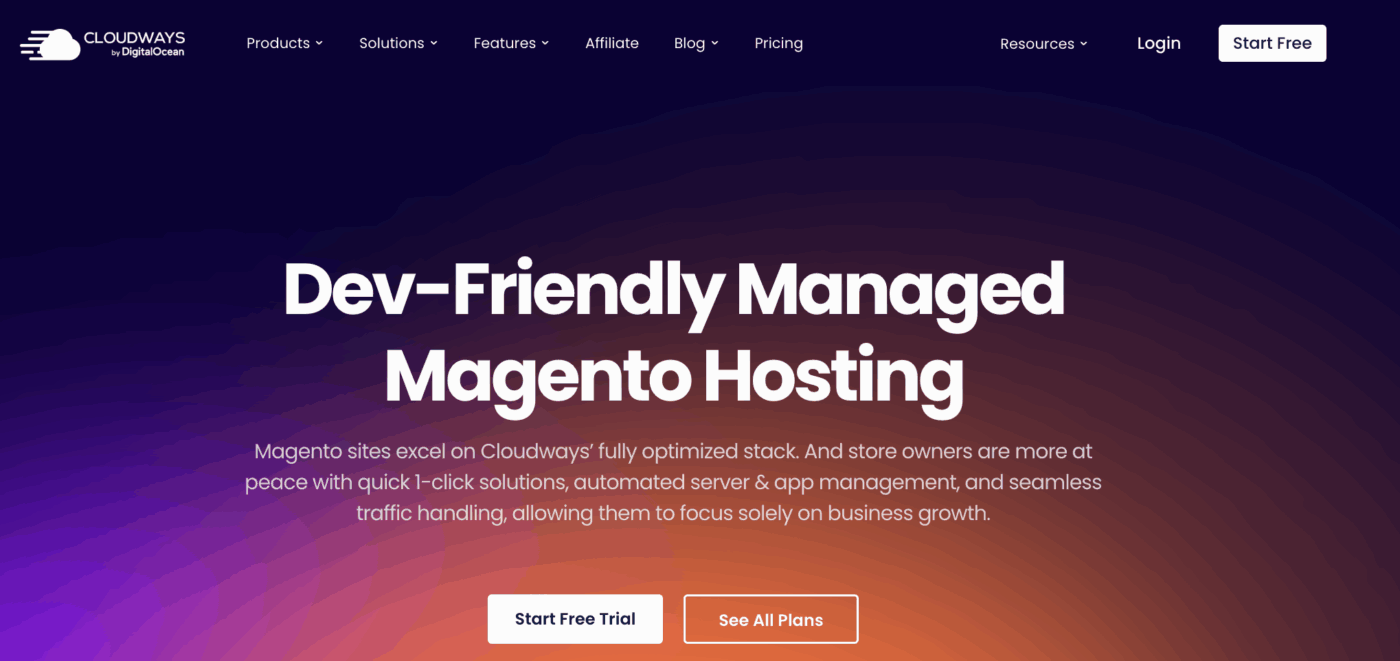
Cloudways also gives developers and agencies a flexible way to host Magento on the cloud, without the hassle of direct server management. You can choose your cloud provider—DigitalOcean, AWS, Google Cloud, and more—and deploy a Magento environment in just a few clicks.
With full-page caching, built-in security, and Cloudflare Enterprise integration available, it balances performance with hands-off scalability. The control panel is intuitive and developer-friendly, making it easy to manage multiple stores or clients.
Features:
- Supports multiple cloud providers (DigitalOcean, AWS, GCP, etc.)
- 1-click Magento installation with ready-to-go performance stack
- Full-page cache, Redis, and Varnish support
- Cloudflare Enterprise add-on for enhanced security and CDN
- Pay-as-you-go pricing and vertical scaling options
Best for: Agencies, developers, or freelancers who want freedom with structure
Starting at: $11/month
3. Hostinger
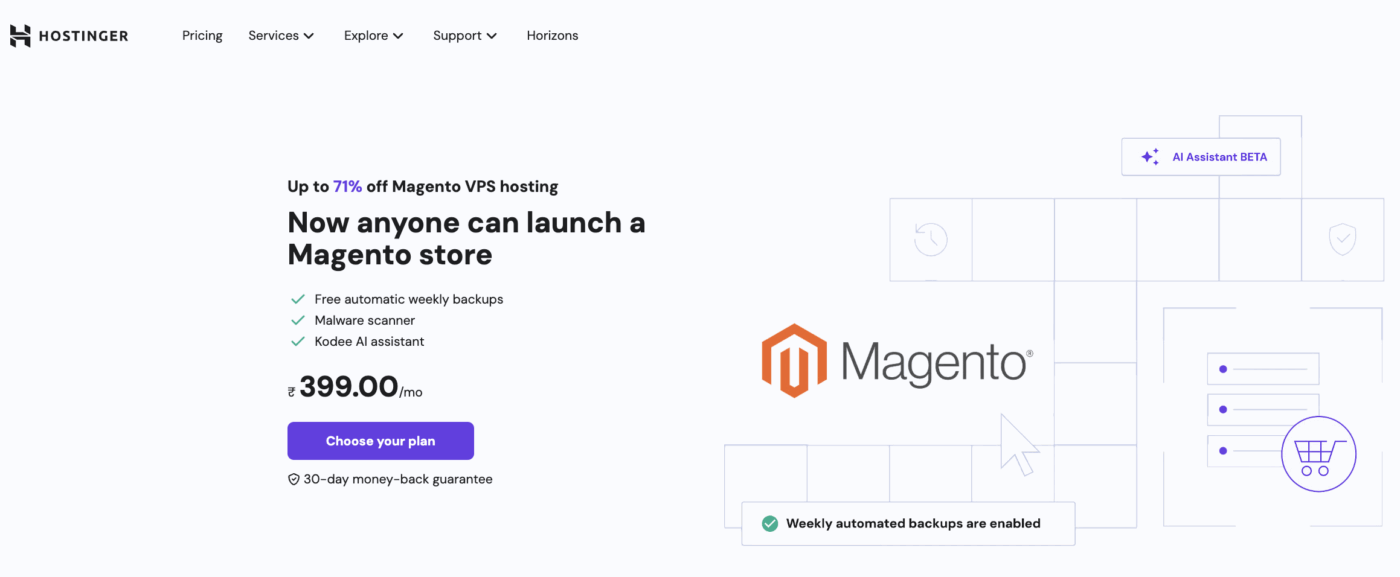
Hostinger offers a cheap path to Magento hosting with VPS plans that can be configured for Magento 2. While not exclusively Magento-focused, it delivers decent performance and good control for the price.
Each plan comes with NVMe SSD storage, full root access, and a dedicated IP, so it’s easy to tailor. Hostinger also includes AI tools that assist with troubleshooting and performance insights, which is helpful for users who are still learning server management.
Features:
- VPS hosting pre-configured for Magento compatibility
- NVMe SSD storage and dedicated IPs
- Root access and full OS control
- DDoS protection and advanced firewalls
- AI-powered server assistant and monitoring
Best for: Small businesses or startups on a tight budget
Starting at: $5.99/month
4. ScalaHosting

ScalaHosting combines customizable cloud VPS hosting with a user-friendly control panel designed to replace cPanel. Their SPanel includes built-in security, performance tuning, and Magento compatibility for growing stores.
You can scale resources on demand and get daily backups, snapshots, and staging environments at no extra cost.
It’s not Magento-exclusive, but ScalaHosting provides a reliable middle ground between unmanaged VPS and full enterprise hosting.
Features:
- Scalable cloud VPS with isolated resources
- SPanel for easy management and cost savings
- Daily snapshots and automatic backups
- Dedicated IPs and strong baseline security
- Optional managed support for Magento setup and tuning
Best for: Ecommerce stores that need flexibility without losing simplicity
Starting at: $29.95/month
5. Hosting.com

Hosting.com (formerly A2 Hosting) focuses on speed and control. It’s a good option for developers who want to manage their own Magento environment. You get root access, optional management, and a full LAMP/LEMP stack to configure Magento the way you want.
While it’s not purpose-built for Magento, the tools and performance features make it a reliable foundation for tech-savvy users.
Features:
- Turbo servers for faster PHP and MySQL execution
- Full root access and custom stack configuration
- Free daily backups and SSL
- Optional managed hosting plans are available
- Developer-friendly tools and staging support
Best for: Experienced users who want full control over their Magento stack
Starting at: $6.99/month
Conclusion
Magento hosting isn’t just about server space. It’s about building a stable and scalable foundation for your entire e-commerce operation. Generic plans often lead to performance bottlenecks and lost sales.
Start by evaluating your traffic, technical resources, and budget. Then match those needs with a provider offering the right balance of performance, support, and Magento-specific features.
FAQs
1. Is Magento hosting more expensive than regular hosting?
Typically, yes. Magento requires more server resources and expert-level configuration, which raises the cost, but it also prevents performance issues that could hurt your business.
2. Do I need managed Magento hosting?
If you don’t have a full-time developer or sysadmin, managed hosting is strongly recommended. It handles security patches, performance tuning, and support automatically.
Even if you do have a full-time dev team, managed hosting can still take a load off their shoulders. If your IT teams are busy already, they might appreciate the added support of managed hosting.
3. Can I host Magento on shared hosting?
It’s possible, but not ideal. Magento’s demand for memory and processing power often exceeds what shared plans can provide. Most stores experience frequent errors or slowdowns.
Additionally, shared hosting is the least secure option, which is not something you want to deal with.
4. Which host is best for large Magento stores?
There’s no one-size-fits-all “best” for hosting. It really depends on your unique needs and preferences. Liquid Web is largely considered a premium option for large and small stores, though, because of its wide range of server types, Magento-tuned stack, and 24/7 support from certified experts.
5. Does Magento work on cloud hosting?
Yes—Magento performs well on cloud infrastructure if the environment includes caching, Elasticsearch, and compatible PHP/MySQL versions.
