


FedEx address correction surcharge on Shopify and WooCommerce: the $18 line most merchants don’t track
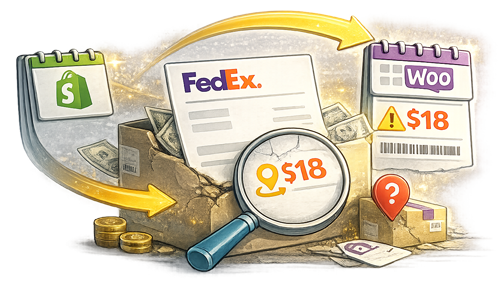
A residential DTC merchant ships 5,000 orders per month. The FedEx invoice arrives at month-end. Buried in the line-item detail, scattered across 200+ shipments, is a recurring $18 surcharge — the address correction fee. The merchant’s finance team flags the total ($3,600 for the month) but the operations lead can’t trace which checkout flow produced the addresses that needed correction. By the time the data is reconstructed, the next month’s billing cycle has the same pattern.
The address correction surcharge applies when FedEx’s network has to correct a destination address mid-route. Common reasons: missing apartment or suite number, abbreviated street name that doesn’t resolve to a single address, ZIP code that doesn’t match the city/state, residential address that needs to be re-classified before delivery. The carrier-side handling is automatic — FedEx corrects the address and completes delivery — but the surcharge applies to the shipment regardless.
For Shopify and WooCommerce merchants whose buyer demographics include any meaningful share of apartment dwellers, rural addresses, or non-standard street formats, the surcharge accrues recurrently. The integration layer is where most merchants either don’t run address validation at all, or run it too late in the workflow to prevent the surcharge.
This article describes what the surcharge actually covers, where the workflow consistently breaks at the checkout-to-label step, and what the integration needs to do for address-correction cost to drop materially.
FedEx’s address correction surcharge applies when the destination address on a shipment label requires correction by FedEx during transit. The current published surcharge runs around $18 per affected shipment (verify against current FedEx published rates before commercial commitments).
Categories that trigger the surcharge:
The FedEx Address Validation API returns standardized address data when called against an input address. The API returns one of several response classifications: validated and standardized, requires correction with suggestions, residential vs commercial classification, or unresolvable. The integration layer is responsible for using the API at the right point in the merchant’s workflow.
Three patterns show up consistently across residential-DTC merchants on Shopify and WooCommerce:
1. Address validation skipped at checkout. The most common failure. The merchant’s Shopify or WooCommerce checkout accepts whatever address the buyer types, with no carrier-level validation. The integration generates the FedEx label with the buyer’s raw input. FedEx’s network attempts delivery, identifies the address issue, corrects it mid-route, and applies the $18 surcharge. The fix is FedEx Address Validation called at the checkout step before payment, with corrections shown to the buyer in real-time for confirmation.
2. Address validation called at label generation — too late. A subtler failure. Some integrations call address validation at the label step rather than checkout. The validation catches the address issue, but the order has already completed checkout with the wrong address; the merchant either ships with the wrong address (and incurs the surcharge) or pauses fulfillment to contact the buyer for correction (which delays the order). The right pattern is checkout-step validation so the buyer can correct the address before payment completion.
3. Generic address suggestions used instead of FedEx-specific validation. A specific failure mode. Some merchants rely on the platform’s native address suggestion features (Shopify’s address autocomplete, generic geocoding) without calling FedEx’s Address Validation API. The platform-level suggestions catch some address issues but miss the FedEx-specific classifications (residential vs commercial, FedEx network routing, ZIP-zone validation). The fix is using FedEx’s API for carrier-specific validation in addition to (or instead of) the platform’s generic address suggestions.
These three patterns explain most of the recurring monthly address correction surcharge accumulation.
The workflow that doesn’t break calls FedEx Address Validation at the checkout step before payment. Validated and standardized addresses pass through cleanly. Addresses requiring correction show the suggested correction to the buyer in real-time (“Did you mean Apt 3B?”) with single-click acceptance. Unresolvable addresses prompt the buyer to revise before checkout completion. The integration writes the validated address to the FedEx Ship API call at label generation; the surcharge doesn’t apply because the address is already correct.
For higher-volume residential-DTC merchants — apparel, beauty, home goods, electronics with meaningful apartment-buyer share — the difference between checkout-step validation and post-label correction shows up directly in the address correction surcharge line on the monthly FedEx invoice. The compounding effect across a year of fulfillment is meaningful for any merchant doing 5,000+ orders per month.
Address correction surcharge is one of the published FedEx surcharges that compounds at month-end alongside residential surcharge (BLOG-T11), non-standard container surcharge (BLOG-T58), DAS / Extended DAS (BLOG-T11), and the broader surcharge-stacking story (BLOG-T29). Each is a published surcharge that the carrier-side Rate API will quote correctly when called with the right inputs, and that most multi-carrier shipping apps either skip or under-count at the checkout-to-label workflow.
For FedEx US e-commerce and Operations, address correction surcharge is one of the cleaner workflow improvements available — the Address Validation API is mature, the failure mode is well-understood, and the per-shipment surcharge accumulation is the kind of recurring cost that catches the merchant’s finance team’s attention.
Address validation workflow automation at checkout still feels like one of the under-built capability areas across Shopify and WooCommerce shipping infrastructure for residential DTC.
Happy to connect with anyone on the FedEx US e-commerce / Operations side exploring address-validation workflow automation further.
Address-correction surcharge avoidance also depends on closing the loop between FedEx’s address-validation API and the merchant’s checkout address-capture experience. Most DTC checkouts collect addresses through a free-text field with light client-side formatting, then submit the order to the rate engine. By the time the rate engine calls FedEx’s address-validation endpoint, the buyer has already left the checkout flow and the corrected address either goes back to the buyer through a delayed support touchpoint or gets quietly auto-corrected without buyer visibility. Pushing the address-validation step earlier — at the checkout address-entry stage, with FedEx’s suggested corrections surfaced to the buyer in real time — converts a downstream surcharge into an upstream UX nudge. The same address-validation call also catches apartment-unit-missing errors, ZIP-plus-4 gaps, and street-suffix issues that drive a different cluster of delivery-attempt failures. The integration cost is one extra API call per checkout; the per-shipment surcharge saved compounds across the merchant’s monthly Ground volume.
This article reflects patterns observed across PluginHive’s residential-DTC merchant base on FedEx. FedEx address correction surcharge specifics, current surcharge values, Address Validation API capabilities, and classification rules should be verified against current FedEx Developer (fdx) documentation before commercial commitments.
PluginHive shipping solutions for FedEx integration on WooCommerce and Shopify.

Direct FedEx integration for WooCommerce — addresses the workflow gaps covered in this article.
Shopify app with native FedEx integration — addresses the workflow gaps covered in this article.
Multi-carrier label generation for Shopify across FedEx and other carriers — addresses the workflow gaps covered in this article.