


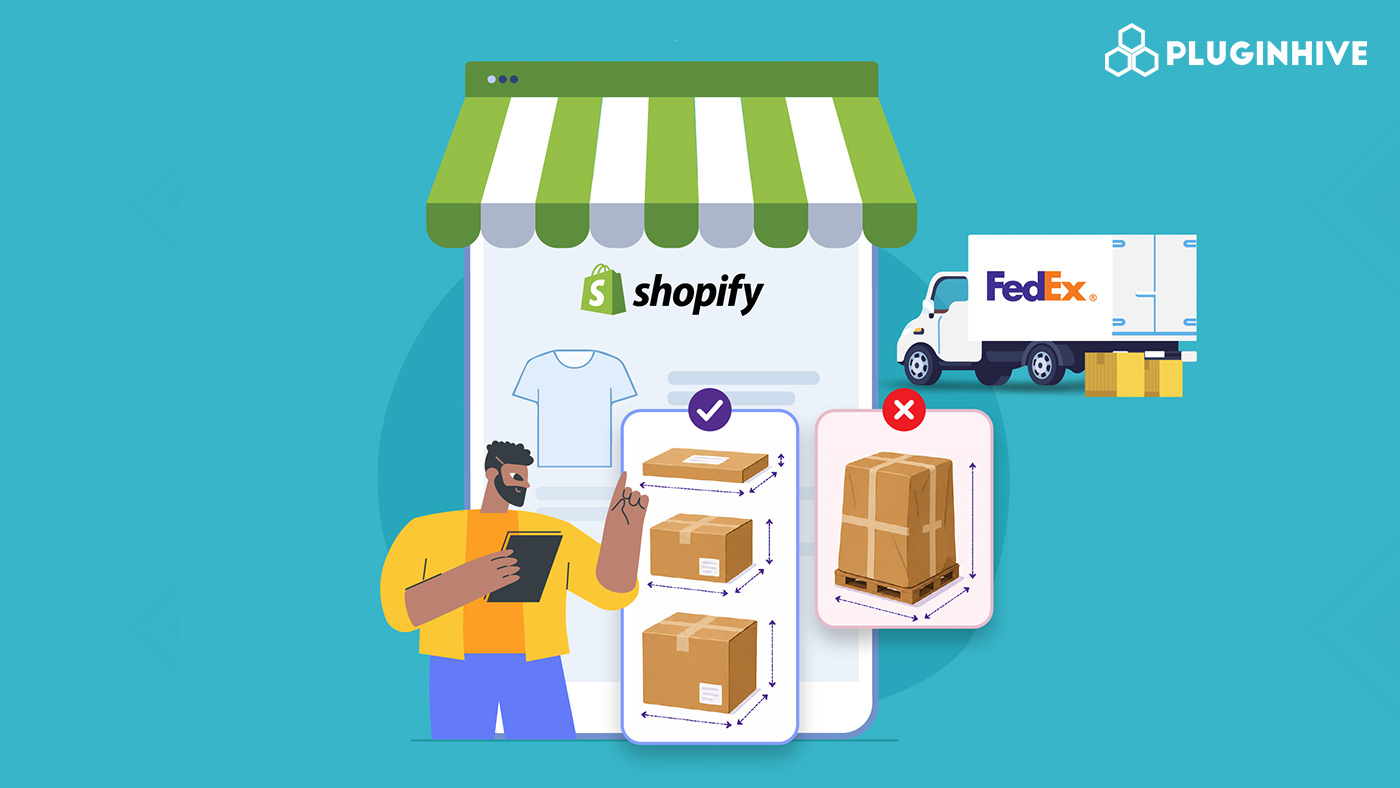
If you ship through FedEx on Shopify, a few things eat into your margin faster than unexpected oversize charges. They show up on invoices after the fact; they aren’t always obvious at the time of packing, and they compound quickly across high-volume fulfillment. The core issue is that many Shopify merchants understand FedEx pricing in terms of weight alone, but FedEx’s surcharge system is built around FedEx size limits just as much as it is around weight.
Understanding FedEx size limits properly is the foundation of predictable shipping costs. This guide breaks down every dimensional threshold that matters, the surcharges that kick in when those thresholds are crossed, and what Shopify merchants can do to stay firmly on the right side of every one of them.
In This Article:
- How FedEx Defines Package Size in Shopify
- The Three FedEx Size Limit Tiers Shopify Merchants Need to Know
- The Rounding Change That Made FedEx’s Size Limits Stricter
- How to Avoid FedEx Oversize Penalties in Your Shopify Store
- How PH Ship, Rate & Track for FedEx Helps You Stay Within Size Limits
- Shopify FedEx Size: A Quick Reference Table
- FAQ’s
How FedEx Defines Package Size in Shopify
Before anything else, it helps to understand the measurements FedEx uses to assess every package: length, girth, and dimensional (DIM) weight.
- Length and girth are the primary measurements FedEx uses to classify packages. The formula is: Length + (2 × Width) + (2 × Height)
- Length is always the longest side of the package. This combined figure is what FedEx uses to determine whether a package crosses oversize and freight classification thresholds.
Dimensional Weight is how FedEx prices packages that are large relative to their actual weight. Dimensional weight applies when the package is relatively light compared with its volume. If the dimensional weight exceeds the actual weight, charges based on the dimensional weight will be assessed.
To calculate it: multiply length by width by height in inches, then divide by 139 for U.S., Puerto Rico, and international shipments. Your chargeable weight is the greater of the actual weight or the dimensional weight.
The Three FedEx Size Limit Tiers Shopify Merchants Need to Know
FedEx applies a structured surcharge system based on package size and weight. These thresholds determine how carriers price shipments and whether they remain eligible for standard parcel shipping.
Crossing from one level to another can significantly increase shipping costs, often without an obvious warning during packing.
Tier 1: Additional Handling Surcharge Dimension
This is the first size-based surcharge Shopify merchants typically encounter.
The Additional Handling Surcharge (AHS) Dimension applies when a package exceeds specific size thresholds, including:
- Longest side greater than 48 inches, or
- The second-longest side is greater than 30 inches
For Shopify merchants shipping furniture components, sporting goods, or large home goods, many standard cartons can easily cross these limits without appearing “oversized” at first glance.
The Additional Handling Surcharge is applied per package and varies by service type and shipping zone.
Tier 2: FedEx Oversized Dimensions Charge
The Oversize Charge is the next threshold beyond Additional Handling.
FedEx defines a package as oversize when it exceeds:
- 96 inches in length, or
- 130 inches in length + girth
When a package qualifies as oversize:
- A minimum billable weight of 90 lbs is applied
- Shipping charges are based on the greater of actual weight or dimensional (DIM) weight
Importantly:
- The Oversize Charge replaces the Additional Handling Surcharge; it does not stack
- If multiple Additional Handling criteria apply, only the highest applicable surcharge is charged
Tier 3: Freight Classification (Unauthorized Package)
At this level, packages exceed FedEx’s maximum parcel shipping limits.
FedEx defines the maximum allowable limits for standard package services as:
- 150 lbs maximum actual weight, or
- 165 inches maximum length + girth
Packages exceeding these limits are no longer accepted within the standard parcel network.
Instead, they may:
- Incur an Unauthorized Package Charge, or
- Be rejected or redirected to FedEx Freight services
These charges are among the highest in the FedEx surcharge structure and are automatically applied if non-compliant packages enter the network.
The Rounding Change That Made FedEx’s Size Limits Stricter
Shopify merchants who haven’t revisited their packaging since mid-2025 may be working with outdated assumptions. Effective August 18, 2025, FedEx updated how it measures package dimensions for billing. Under this change, carriers round up every fractional inch or centimeter to the next whole number. This change sounds minor, but it has real cost implications. Before this update, fractional measurements below certain thresholds could effectively reduce the calculated size of a package. Now, even the smallest fraction increases the billed dimensions.
For example:
A package measuring 21.2″ × 21.4″ × 21.6″ is now billed as 22″ × 22″ × 22″
For Shopify merchants, the impact is significant:
- Packages that were previously just under key FedEx size limits may now exceed them
- Higher rounded dimensions can increase DIM weight, leading to higher shipping charges
- Shipments near surcharge thresholds are now far more likely to trigger Additional Handling or Oversize fees
How to Avoid FedEx Oversize Penalties in Your Shopify Store
Avoiding extra charges in Shopify shipping starts with understanding how FedEx evaluates package size.
Measure Your Actual Shipping Boxes
- Record the outer dimensions (length, width, height) of every box used in fulfillment and calculate length + girth (L + 2W + 2H), since FedEx uses external measurements to determine size limits and surcharge eligibility
- Identify and flag boxes that are approaching 96 inches in length or 130 inches in length + girth, as these are the key thresholds where oversize charges begin
Optimize Packaging to Stay Within Limits
- Evaluate whether splitting shipments into multiple smaller packages keeps each box within FedEx size limits, especially for multi-item Shopify orders where one large box may trigger oversize fees
- Compare total shipping costs between one oversized package and multiple standard packages, since avoiding even a single oversize surcharge can significantly reduce overall costs
Use Right-Sized Packaging for Low-Density Products
- Use packaging that closely fits the product to minimize unused space, as FedEx pricing is based on dimensional (DIM) weight, which increases with larger box sizes
- For bulky but lightweight items (like apparel or cushions), use compression or flexible packaging to reduce dimensions and avoid unnecessary shipping cost increases
Keep Shopify Product Dimensions Accurate
- Ensure Shopify product dimensions reflect the actual packed box size, including padding and inserts, rather than just the product’s raw dimensions
- Regularly audit your catalog to prevent mismatches that can lead to inaccurate checkout rates, which may either reduce margins or inflate customer-facing shipping costs
How PH Ship, Rate & Track for FedEx Helps You Stay Within Size Limits
Managing FedEx size limits manually across a growing Shopify product catalog is time-consuming and error-prone. PH Ship, Rate & Track for FedEx by PluginHive is built to handle this automatically, enforcing accurate dimensional data at every stage of the fulfillment process.
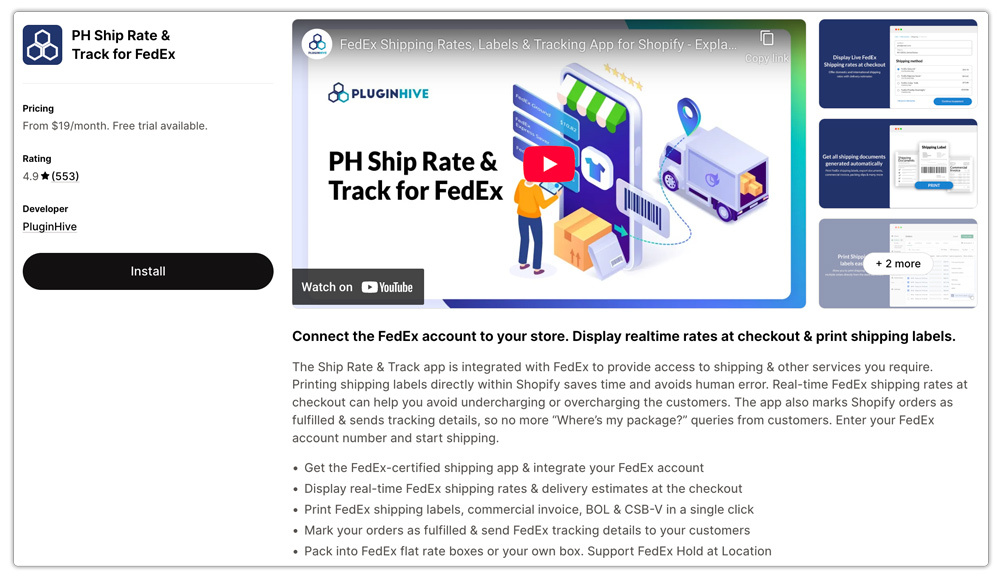
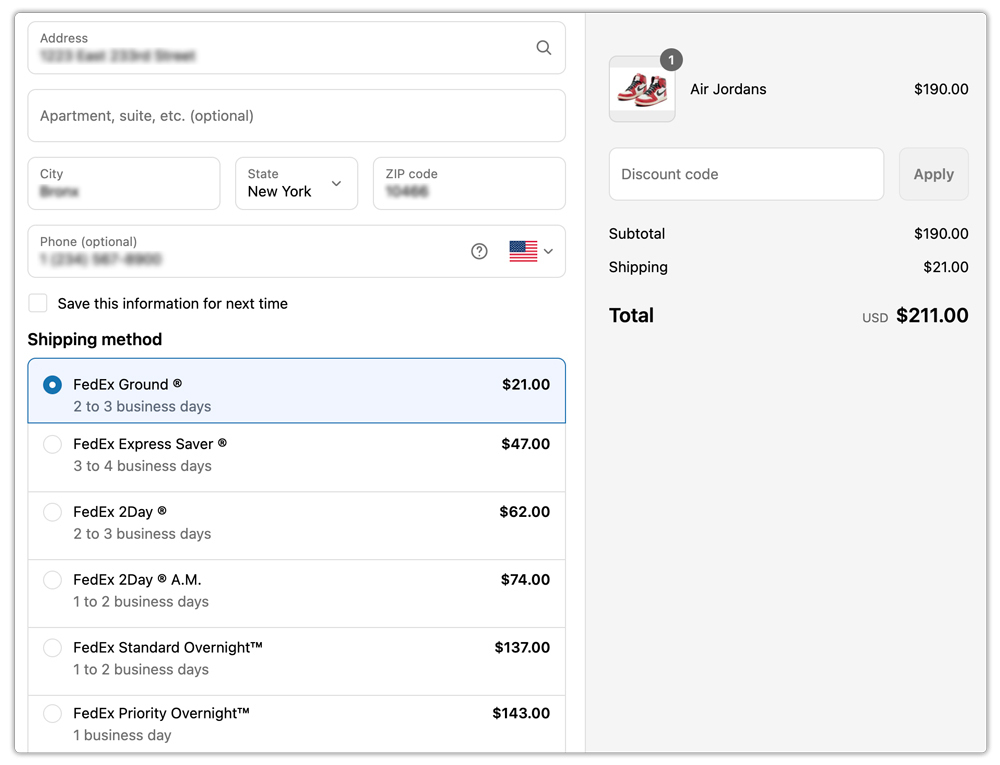
Accurate Dimensional Rate Calculation at Checkout: The app pulls your configured product dimensions and packaging settings and sends them to FedEx’s API to return live, accurate rates that account for dimensional weight, oversize thresholds, and applicable surcharges.
Box Packing Mode with Size Limit Awareness: You can configure your real-world box inventory in the app, including both inner and outer dimensions, box weight, and maximum capacity. When an order comes in, the app selects the most efficient box from your configured options.

Dimensional Surcharge Handling: The app is explicitly designed to handle FedEx’s dimensional surcharge rules. If a product’s dimensions exceed 48 inches, the app sends the dimensional data to FedEx so it can calculate the applicable surcharge and reflect it in the checkout rate.

Rates Log for Diagnosing Size-Related Discrepancies: When a rate doesn’t look right, the app’s Rates Log lets you trace the exact inputs that produced it, including the dimensions and packaging type that were sent to FedEx. This makes it straightforward to identify which package configuration is causing an unexpected charge.

Shopify FedEx Size: A Quick Reference Table
Here is a summary of FedEx size limits and surcharge triggers based strictly on official FedEx documentation:
| Threshold | What Triggers It | Consequence |
|---|---|---|
| Cubic volume > 10,368 in³ | Additional Handling Surcharge Dimension applied | Per-package surcharge applied based on service and zone |
| Longest side > 48″ OR second-longest side > 30″ OR Length + Girth > 105″ | Additional Handling Surcharge Dimension applied | Per-package surcharge; only one AHS applies per package |
| Length > 96″ OR Length + Girth > 130″ | Oversize Charge | Per-package surcharge; 90-lb minimum billable weight applies |
| Cubic volume > 17,280 in³ OR actual weight > 110 lbs. | Oversize Charge | Same Oversize Charge applies; expands eligibility |
| Weight > 150 lbs. OR Length + Girth > 165″ | Unauthorized Package / Freight threshold applied | The package may be rejected or incur an Unauthorized Package Charge |
Conclusion
FedEx pricing isn’t based solely on weight; package size heavily influences it. Even small changes in dimensions can push shipments beyond FedEx’s size limits and increase shipping costs without warning.
For Shopify merchants, the key is simple: use the right packaging, track your box dimensions accurately, and stay below critical thresholds wherever possible. When your setup aligns with how FedEx actually calculates surcharges, you avoid surprises and protect your margins.
In high-volume Shopify shipping, controlling size is one of the most effective ways to keep costs predictable and profitable.
FAQ’s
Q. What are the maximum FedEx size limits for standard packages?
FedEx allows packages up to 150 lbs in actual weight and a maximum of 165 inches in length + girth (L + 2W + 2H). If a shipment exceeds these limits, carriers may reject it, apply an Unauthorized Package Charge, or require you to ship it via FedEx Freight.
Q. When does FedEx apply the Oversize Charge?
The Oversize Charge applies when a package exceeds:
- 96 inches in length, or
- 130 inches in length + girth
Once triggered, carriers apply a minimum billable weight of 90 lbs, even if the package weighs less.
Q. What triggers the Additional Handling Surcharge (Dimension)?
FedEx applies the Additional Handling Surcharge when a package exceeds certain size thresholds, including:
- Longest side greater than 48 inches
- The second-longest side is greater than 30 inches
- Length + girth greater than 105 inches
Q. Does FedEx charge based on actual weight or dimensional weight?
FedEx charges based on the greater of actual weight or dimensional (DIM) weight. Carriers calculate DIM weight using package dimensions, so larger boxes, even if lightweight, can significantly increase shipping costs.
