



Expanding your Shopify store beyond borders opens up a world of opportunity, but it also comes with customs paperwork, duty decisions, and documentation requirements that can trip up even experienced merchants. UPS international Delivery offers a reliable, structured way to navigate all of this, with a global network, built-in customs tools, and flexible service options for every shipping need.
This guide walks Shopify merchants through the key components of UPS international shipping: the available services, how duties work, what HS codes are, and which forms you’ll need to ship compliantly.
Table of Contents
- UPS International Delivery Services Available for Shopify Merchants
- Understanding Duties and Taxes in UPS International Delivery
- DDP vs. DDU: What Shopify Merchants Need to Know
- What Are HS Codes and Why Do They Matter in UPS International Delivery
- Required Forms for UPS International Shipping in Shopify
- Simplify Shopify UPS International Shipping with PH MultiCarrier Shipping Label App
- Conclusion
- FAQ
UPS International Delivery Services Available for Shopify Merchants
UPS offers a range of international shipping services to help you reach new markets. Here’s a breakdown of what’s available:
- UPS Worldwide Express / Worldwide Saver: 1–3 day delivery is available with Worldwide Express and Worldwide Saver (by the end of the day).
- UPS Worldwide Expedited: For important but not critical shipments, UPS Worldwide Expedited delivers in 2–5 business days.
- UPS Standard: UPS Standard offers day-definite delivery in 2–7 days with Saturday delivery available for most regions.
- UPS Worldwide Economy: UPS Worldwide Economy is a cost-effective option for non-urgent international shipments, with typical transit times of 5–8 days for DDP shipments and 5–12 days for DDU shipments.
Shopify merchants can choose the service level that fits their products, customer expectations, and cost targets.
Understanding Duties and Taxes in UPS International Delivery
Customs authorities commonly use the term “customs” to refer to the duties, fees, and taxes they charge on items shipped from one country to another. The type of items and the origin and destination countries determine the shipping costs.
The landed cost is the total expense of shipping a product. For international shipments, the landed cost includes applicable duties, taxes, and fees.
The shipment details determine the cost of an international shipment, including the value of the items, the country of manufacture, the origin and destination countries, and the purpose of the shipment.
Either the shipper or the receiver will be responsible for payment of duties, taxes, and fees. In rare instances, a third party may pay these charges.
DDP vs. DDU: What Shopify Merchants Need to Know
When you ship internationally with UPS, one of the most important decisions is who pays the duties: you or your customer.
Delivery Duty Paid (DDP)
Delivery Duty Paid (DDP) refers to an Incoterms rule that dictates that the shipper is responsible for all costs associated with a cross-border shipment, including export clearance, transport costs, duties, taxes, and any associated fees.
When retailers choose to ship DDP, their customers have a full picture of shipping costs at checkout and are not hit with any additional fees once their product has arrived.
Delivery Duty Unpaid (DDU)
Delivery Duty Unpaid (DDU) means the customer covers duties, fees, and taxes to ship the product. Shipping DDU can be the right strategy for cost management, particularly for lower-value items.
Which should you choose? Retailers who want to prioritize a simplified and seamless customer experience will likely choose to ship DDP so their shoppers are not surprised by additional fees upon delivery. For higher-volume or lower-value products, DDU may be more practical from a cost perspective.
What Are HS Codes and Why Do They Matter in UPS International Delivery
HS codes are a critical part of UPS’s international shipping compliance. The HS Code is an international index used for categorizing goods, enabling consistent classification and taxation. The HS Code consists of 21 sections and numerous subsections that allow shippers to describe their goods in great detail using only numbers.
Harmonized System Codes (or tariff codes) are used by customs authorities to identify products being shipped, so they can accurately assess any duties and taxes owed. An incorrect code can lead to customs delays or even fines.
A few best practices for Shopify merchants:
- Look up your HS code before creating your shipping label, not after
- Use the most specific code available for each product
- Providing the product’s HS code helps ensure that import charges will be assessed accurately and helps ensure customs clearance
- Review codes periodically, as the World Customs Organization updates the HS code system regularly
Required Forms for UPS International Shipping in Shopify
Getting your documentation right is the foundation of smooth international shipping. Here’s what UPS requires:
Commercial Invoice
All cross-border shipments require a commercial invoice. Customs authorities use it as the primary document to assess duties and taxes and verify compliance with import and export regulations.
To complete a commercial invoice, provide details about the shipment, including a description of the items and the value of each product being shipped.
UPS Paperless Invoice
Opening a new UPS account will automatically enroll you in UPS Paperless® Invoice. This is the faster, cleaner option for most Shopify merchants.
UPS Paperless Invoice lets you submit all required shipment information electronically, reducing the likelihood of customs delays caused by incomplete documentation. It’s free of charge and works with UPS shipping systems.
Packing List
A packing list is an optional document that allows shippers to give specific details on a shipment’s contents.
A packing list cannot replace a commercial invoice because customs authorities do not use it to assess the duties, taxes, and fees associated with a shipment.
Certificate of Origin
A certificate of origin verifies the country in which the shipped items were manufactured. Customs authorities may require this document for certain goods or to qualify for trade agreement benefits.
Simplify Shopify UPS International Shipping with PH MultiCarrier Shipping Label App
Managing all the moving parts of UPS international shipping services, duties settings, and commercial invoices manually is time-consuming. The PH MultiCarrier Shipping Label App by PluginHive brings this workflow inside your Shopify store.
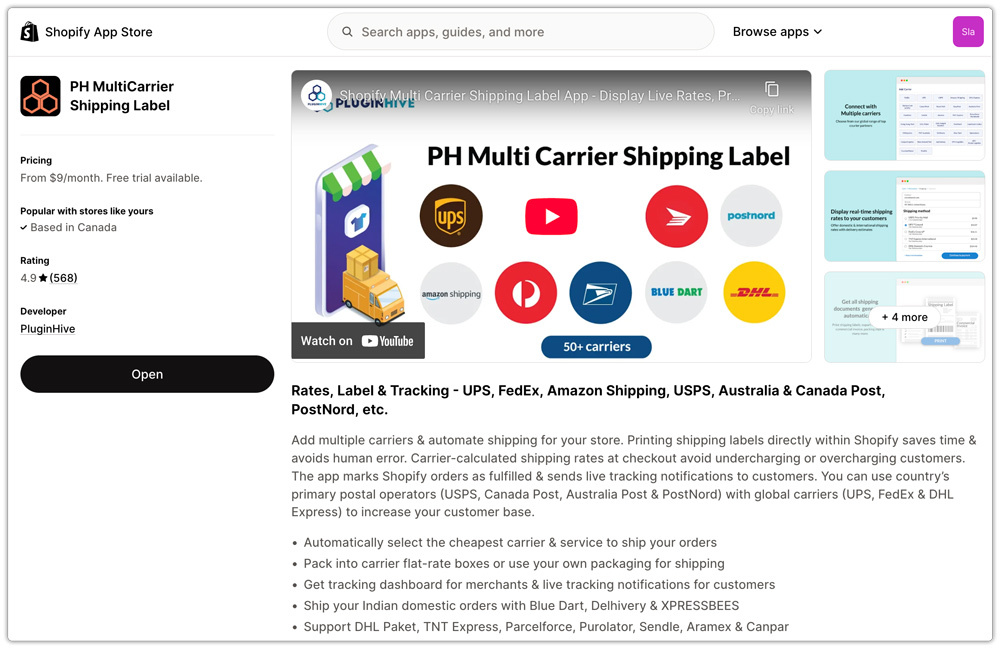
Here’s how it helps with international orders:
- Connect your UPS account directly: Link your UPS account to Shopify and access all international UPS services, including Worldwide Express, Worldwide Expedited, Worldwide Economy, and more.
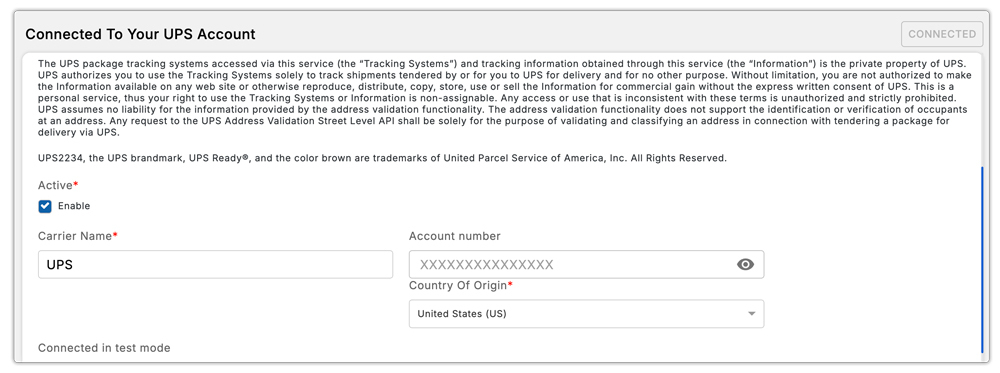
- Display accurate international rates at checkout: Show real-time UPS rates that account for destination, weight, and dimensions.

- Generate international shipping documents: Create commercial invoices and other required customs documents alongside your UPS label, without switching tools.

- DDP/DDU support: Configure duty payment preferences per shipment so your checkout experience stays transparent for international customers.

- Bulk label printing: Process multiple international orders at once, saving time when shipping cross-border at volume.

For Shopify merchants scaling internationally, the PH MultiCarrier Shipping Label App removes the friction of managing UPS international shipping documentation and settings across multiple orders.
Conclusion
UPS international shipping gives Shopify merchants a robust, globally trusted carrier network, but taking full advantage of it requires understanding the details: which service matches your delivery promise, how DDP and DDU affect your customer experience, and how accurate HS codes and complete customs forms prevent delays. Getting these right from the start protects your margins, keeps customers happy, and keeps your shipments moving.
FAQ
Q. What is the difference between DDP and DDU in UPS international shipping?
DDP (Delivery Duty Paid) means the shipper covers all duties and taxes. DDU (Delivery Duty Unpaid) means the recipient pays duties upon delivery. DDP typically provides a better customer experience, while DDU suits lower-value or high-volume shipments.
Q. Is a commercial invoice always required for UPS international shipping?
All cross-border non-document shipments require a commercial invoice. You can submit it digitally using UPS Paperless Invoice or attach three printed copies to your package.
Q. What is an HS code, and where do I find it?
Customs authorities use an HS code, an internationally standardized number, to classify goods. In the US, this extends to a 10-digit HTS code. You can look up your product’s code on the US International Trade Commission website before creating your UPS shipping label.
