


Setting Up PH WooCommerce Deposits plugin
PH Deposits for WooCommerce lets customers pay a deposit upfront and pay the balance later. With this plugin, you get complete control over how deposits work – force a deposit, or let customers choose between a deposit and full payment. You can apply deposits storewide, to specific products, or to specific product categories and customer roles, and offer flexible payment plans with daily, weekly, monthly or yearly installments. You can also track every deposit order and its balance payment from a dedicated dashboard.
Now let us take you through a step-by-step setup of PH Deposits for WooCommerce plugin on your WooCommerce store.
On this page
- Install and activate the WooCommerce Deposits plugin
- Configure Storewide Deposit Settings
- Set Up WooCommerce Deposit and Payment Plans
- Set Up Reminder Emails for Balance Payments
- Configure Product-Specific Deposits
- Create Deposit Rules by Category and User Role
- Manage deposit orders and orders with payment plans
- Track deposits from the Overview dashboard
- Customize the Deposit Payment Design on Product Pages
- Usage – How Deposit Details Appear to Customers
Install and activate the WooCommerce Deposits plugin
Visit the PH Deposits for WooCommerce plugin page and purchase the plugin. After a successful purchase, the plugin will be available to download at My Accounts > API Downloads. Download the plugin and install it on your WooCommerce store.
Track License Activations and Expiry Reminders
To see when your license was activated and when it expires, go to WooCommerce Deposits → License → API History. The table lists each activation on your site along with its Access Granted Date and Access Expiry Date.
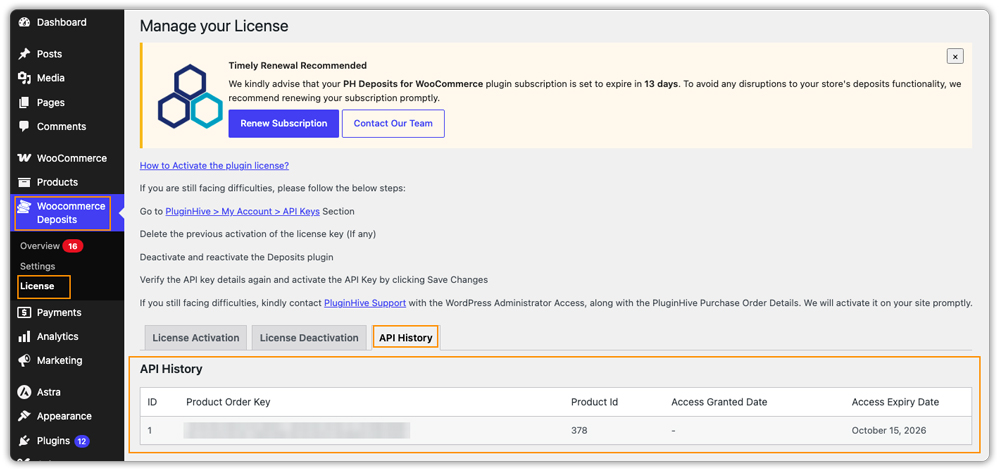
As your license nears expiry, a notice appears in your WordPress dashboard at 16-30 days, 8-15 days, and 7 days or less remaining, and again once the license has expired. Each notice includes a Renew Subscription button that takes you to your PluginHive account.

Access PH Deposits for WooCommerce Settings
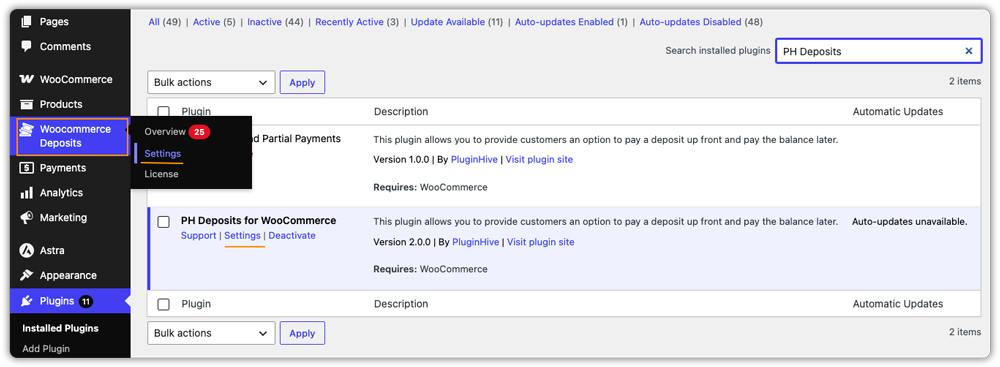
After installing and activating the plugin, you can access its settings from your WordPress dashboard in either of the following ways:
- Go to WooCommerce Deposits → Settings.
- Or, go to Plugins → Installed Plugins, find PH Deposits for WooCommerce, and click Settings.
Configure Storewide Deposit Settings
The Deposit Settings tab lets you configure the default deposit settings for your store. When deposits are enabled, these settings will apply to all products by default. You can later override these settings for individual products, or for specific product categories and user roles using Deposit Rules, which we’ll cover later in this article.
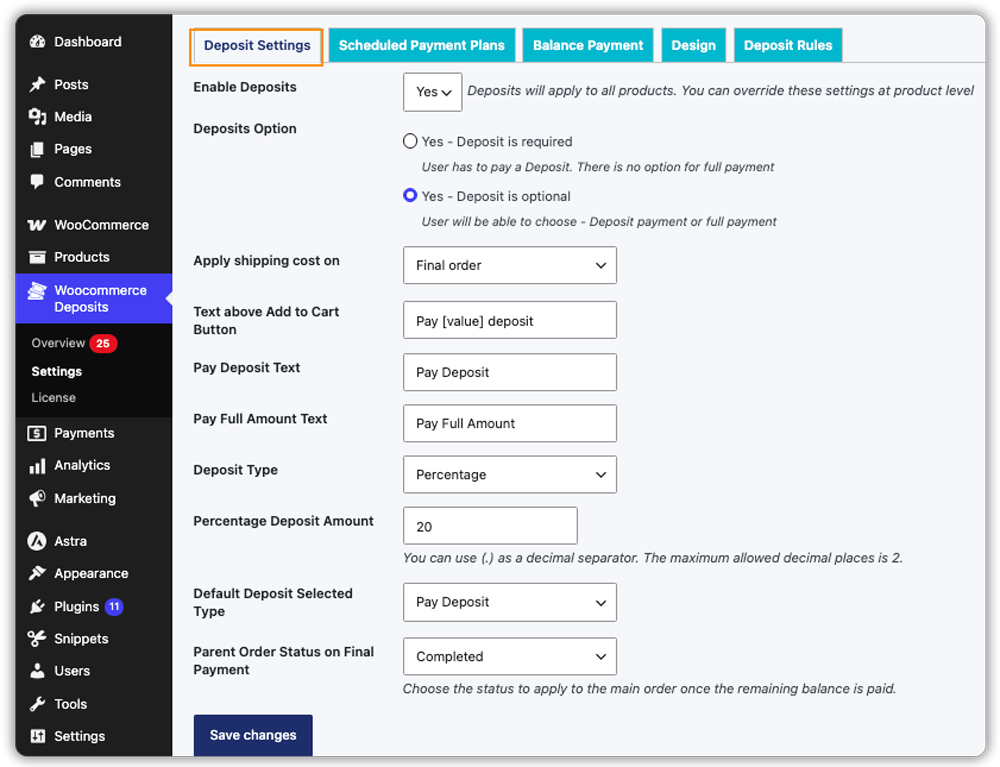
Here’s a walkthrough of each setting on this tab:
Enable Deposits and Set Customer Payment Options
- Enable Deposits: Set to Yes to turn on deposit payments for your store. Deposits will apply to all products by default.
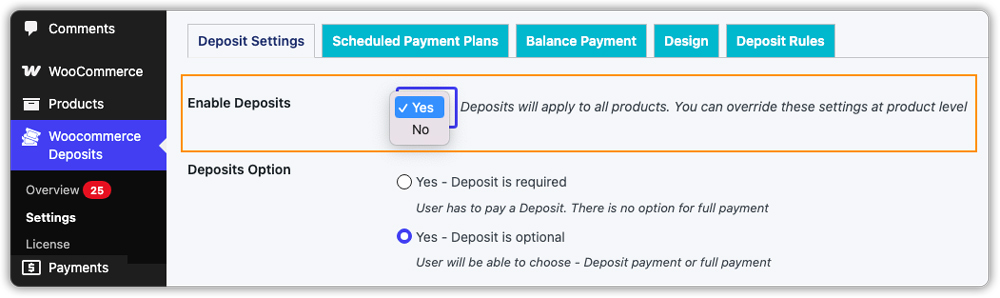
- Deposits Option: This decides how much choice the customer gets at checkout:
- Yes – Deposit is required: Customers must pay the deposit; there’s no full-payment option.
- Yes – Deposit is optional: Customers can choose between paying the deposit or the full amount.

Choose How WooCommerce Shipping Costs Are Applied
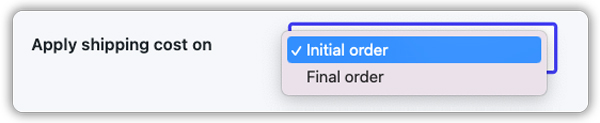
- Apply shipping cost on: Choose when the shipping cost should be charged to the customer:
- Initial order: The shipping cost is charged along with the deposit payment when the customer places the initial order.
- Final order: The shipping cost is charged along with the remaining balance when the customer makes the final payment.
Customize the Payment Option Text
Use these settings to customize the text displayed to customers on the product page:
- Text above Add to Cart Button – Enter the message displayed above the Add to Cart button. For example, “Pay [value] deposit .”
- Pay Deposit Text – Customize the text displayed for the Deposit Payment option. The default text is “Pay Deposit.”
- Pay Full Amount Text – Customize the text displayed for the Full Payment option. The default text is “Pay Full Amount.”

Set the Deposit Type and Default Payment Option
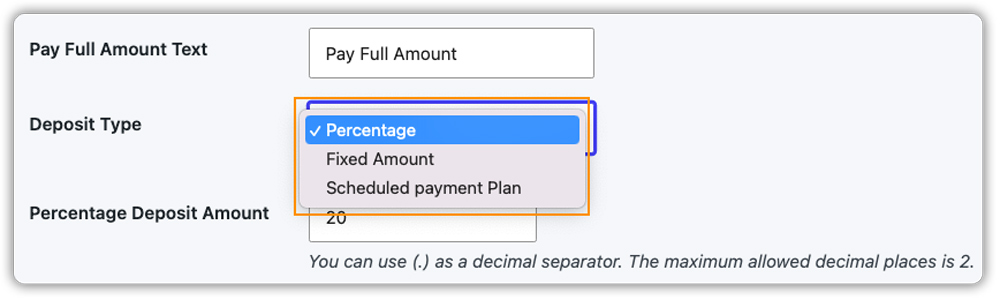
- Deposit Type: Choose how you want to collect the deposit: Percentage, Fixed, or Scheduled Payment Plan. Based on the selected type, the corresponding settings will appear. We’ll cover each deposit type in detail in the following sections.
- Default Deposit Selected Type: Choose whether Pay Deposit or Pay Full Amount is pre-selected on the product page (relevant when Deposits Option is optional). Customers can still switch before purchasing.

Set the Parent Order Status After Final Payment
- Parent Order Status on Final Payment: Choose the order status applied to the parent order once the customer pays the full remaining balance (e.g. Completed). Select None to leave this unchanged.

Click Save changes to apply your settings.
Set Up WooCommerce Deposit and Payment Plans
Once you have decided on the Deposit Type – Percentage Deposit, Fixed Deposit, or Scheduled Payment Plan – configure the settings specific to your selected deposit type to offer deposit payments to your customers.
Here is a detailed breakdown of each deposit type and its corresponding settings.
Percentage Deposit
Use this option if you want the deposit to scale with the price of the product – for example, always collecting 20% upfront, regardless of whether the product costs $50 or $500.
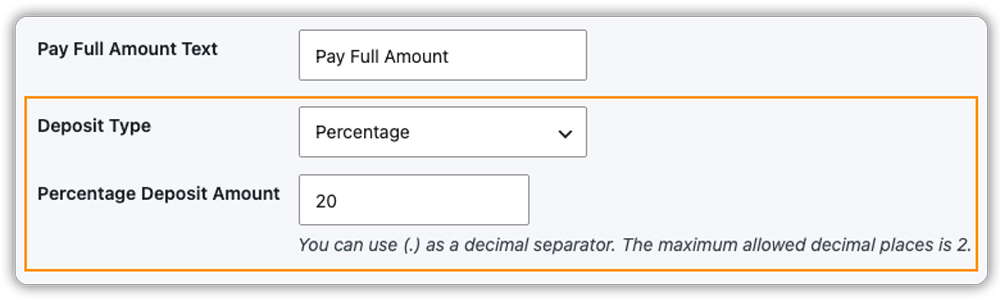
- Set Deposit Type to Percentage.
- Enter the percentage in the Percentage Deposit Amount field that appears (e.g. entering 20 means customers pay 20% of the product price as a deposit).
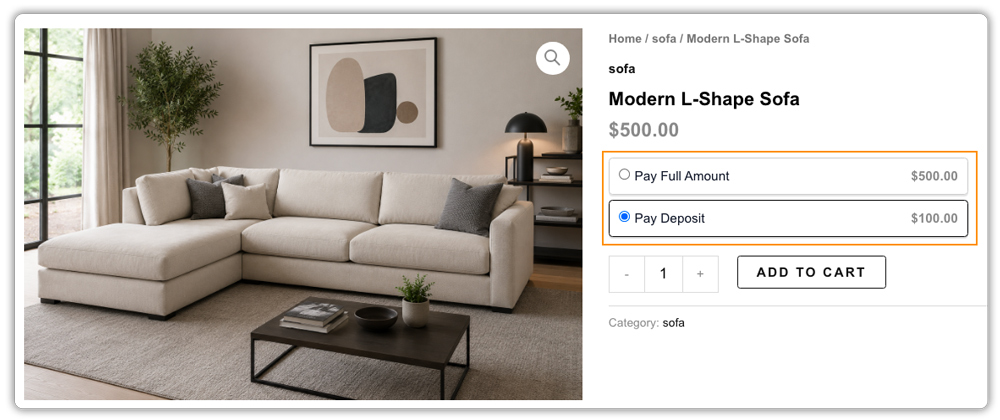
Once saved, the applicable deposit amount will be calculated based on the product price and displayed to the customer when selecting the deposit payment option. For example, a 20% deposit on a $500 product will require an initial payment of $100.
Fixed Deposit
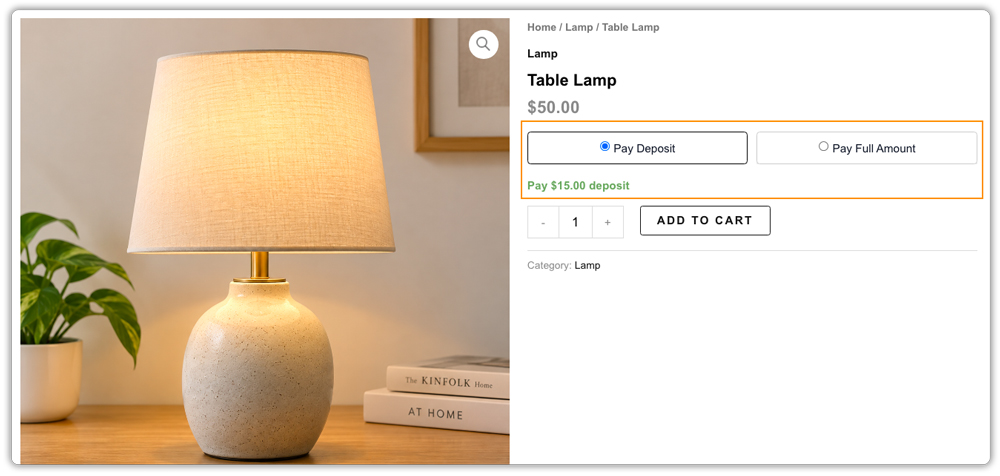
Use this option if you want customers to pay the same deposit amount regardless of the product’s price – for example, a flat $15 deposit whether the product costs $50 or $500.
- Set Deposit Type to Fixed Amount.
- Enter the amount in the Fixed Deposit Amount field that appears (e.g. entering 15 means every customer pays a $15 deposit).

Once saved, the fixed deposit amount will be displayed to the customer as the initial payment when they select the deposit option.
Scheduled Payment Plan
Payment plans let you split the product price into an upfront payment followed by scheduled installments, instead of a single deposit and one balance payment – useful for higher-priced products where customers may want to pay over time.
Go to WooCommerce Deposits → Scheduled Payment Plans. You’ll see an Add Payment Plan form, with your existing plans listed below it.
- Plan Name – Internal name for the plan (shown to customers ).
- Plan Description – A short description explaining the plan to the customer.
- Plan Type – Choose how the installments are scheduled:
- Recurring Payment: Installments repeat at a fixed cycle you define (e.g. every 2 weeks/month).
- Custom Payment: You define each installment individually, with its own amount and timing.

Configure a Recurring Payment Schedule
- Number of Payment Cycles – How many installments the plan should have.
- Every [ ] [Days/Weeks/Months/Years] – How often each installment is charged.
For example, you can set a plan to collect the remaining amount in 8 weekly installments by setting the payment cycle to 1 Week and the number of payment cycles to 8.
Configure a Custom Payment Schedule
Build the schedule row by row:
- Payment Amount – The percentage of the total price for that installment.
- Interval – How long after the previous payment this installment is due (the first row is always charged Immediately).
Use the + and – buttons to add or remove installments. The table keeps a running Total (should add up to 100%) and Total Duration for the plan.
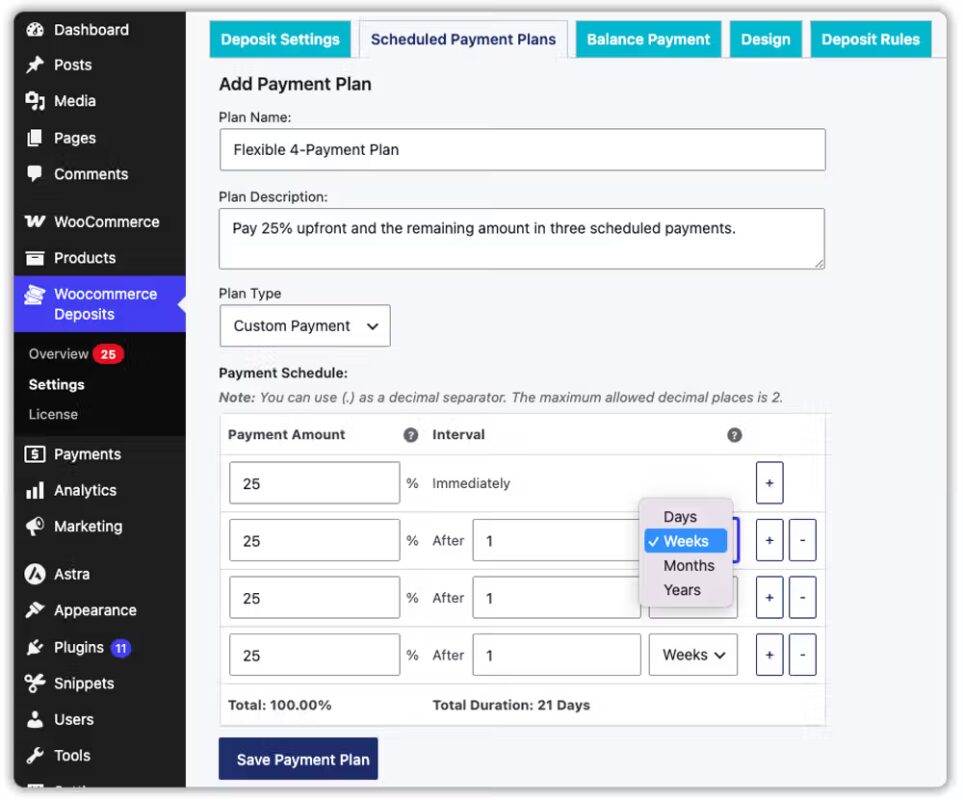
For example, you can create a plan with 25% paid immediately, followed by three 25% payments, with each payment scheduled 1 week apart.
Click Save Payment Plan once you’re done.
Apply the Payment Plan to Your Store
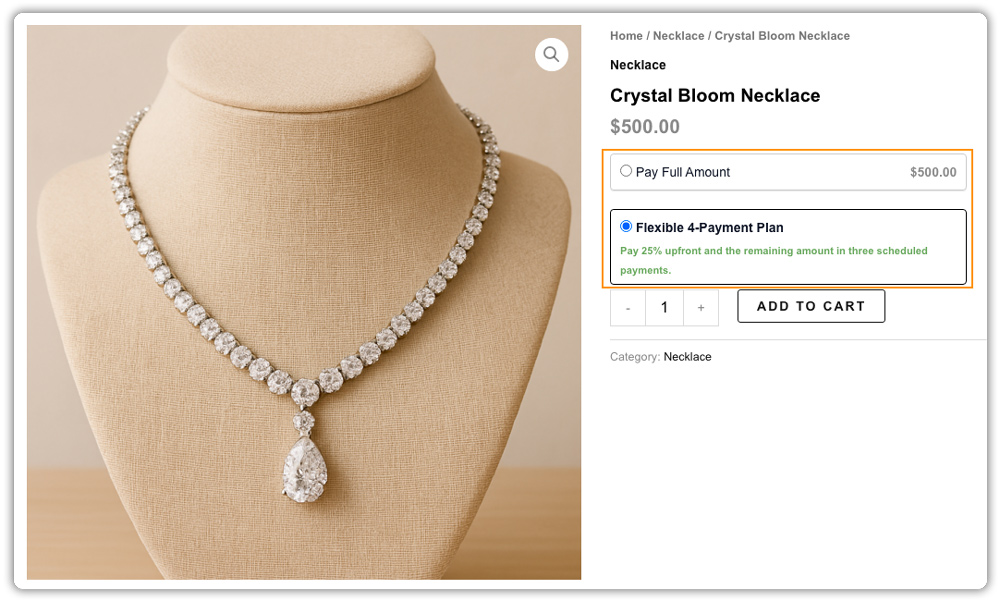
To use a plan storewide, go to the Deposit Settings tab, set Deposit Type to Scheduled Payment Plan, and select the plan(s) to offer under Payment Plans.

Click Save Changes to save the settings. After saving, customers will be able to choose from the payment plans you have created or select the full payment option.
Set Up Reminder Emails for Balance Payments
You can configure the plugin to automatically remind customers when a balance payment is due. These reminders work with Scheduled Payment Plans and with Fixed Amount or Percentage deposits when a balance payment order is created.
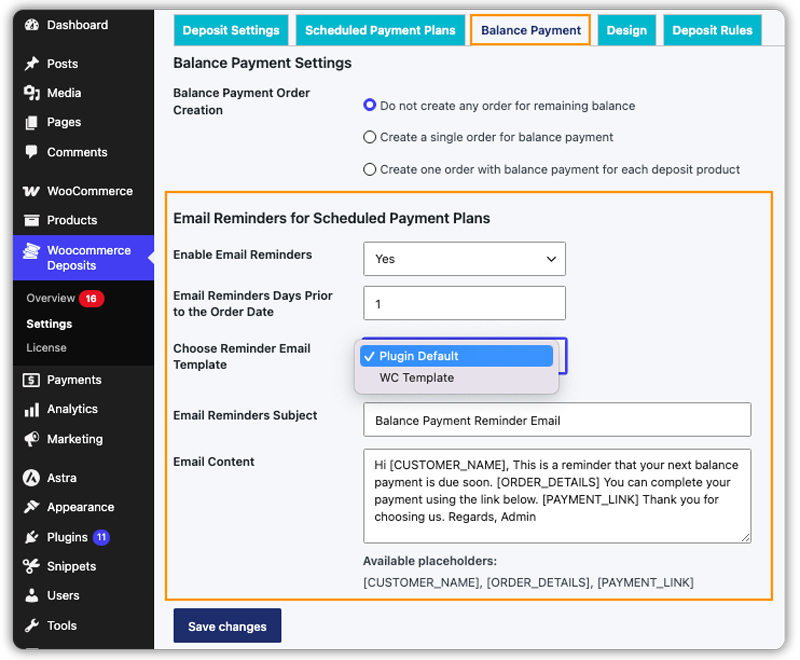
Go to WooCommerce Deposits → Settings → Balance Payment and configure the following settings:
- Enable Email Reminders – Select Yes to enable automatic reminder emails.
- Email Reminders Days Prior to the Order Date – Enter how many days before the due date the reminder should be sent. For example, entering 1 sends the reminder one day before the due date.
- Choose Reminder Email Template – Select Plugin Default to use the plugin’s default email template, or select WC Template to use WooCommerce’s email template.
- Email Reminders Subject – Customize the subject line of the reminder email. The default is Balance Payment Reminder.
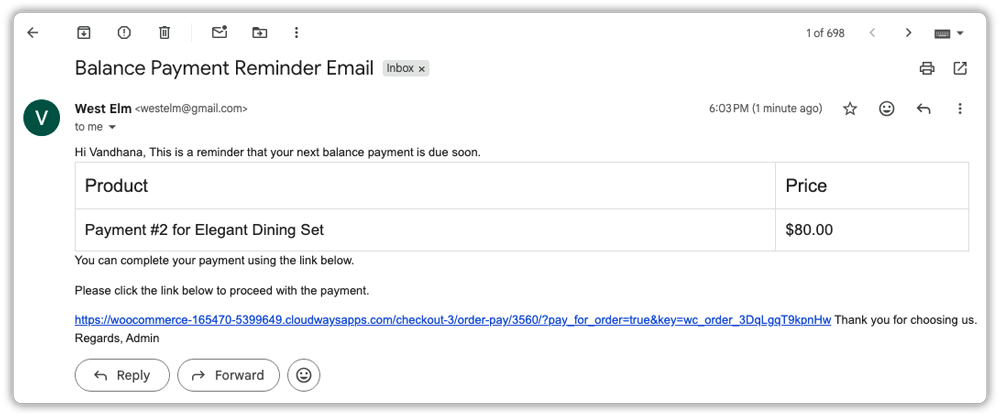
- Email Content – Customize the reminder message. You can use [CUSTOMER_NAME], [ORDER_DETAILS], and [PAYMENT_LINK] to personalize the email.
Click Save Changes once you have configured the settings.
If you select WC Template, a link will appear below the setting after saving. Click the link to customize the reminder email in WooCommerce.

You can customize the email content, choose the email format such as Plain Text, HTML, or Multipart, and preview the email before sending.
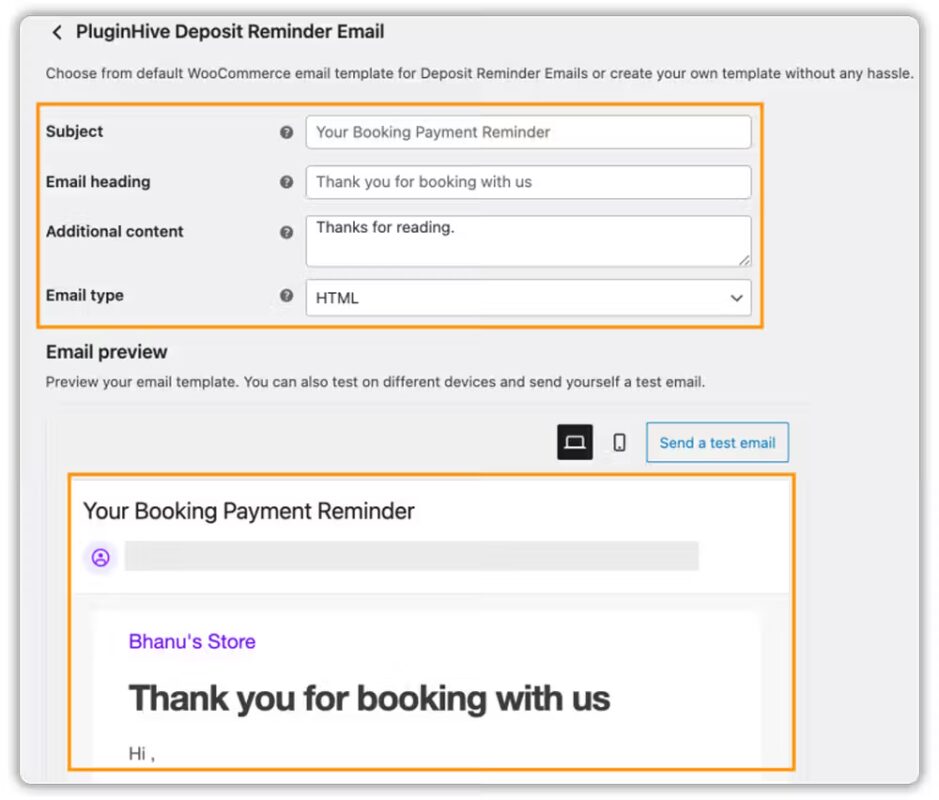
The reminder email will be sent using the WooCommerce email template you have configured.
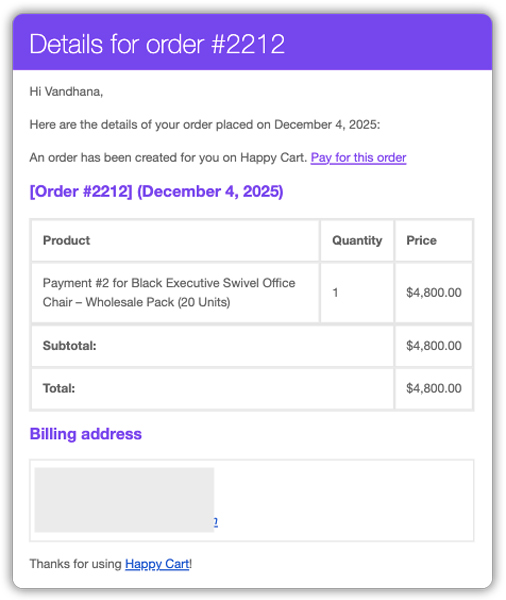
If you select Plugin Default, the plugin’s default reminder email template will be used.
When Are Automatic Reminders Sent?
The reminder behavior depends on how the balance payment is configured:
- Scheduled Payment Plans – Reminders are sent based on each installment’s due date and the Email Reminders Days Prior to the Order Date setting.
- Fixed Amount or Percentage Deposits – Select Create a single order for balance payment or Create one order with balance payment for each deposit product under Balance Payment Order Creation (we’ll cover these options in the upcoming section). This enables Balance Payment Order Creation Days:
- If it is set to 0, the balance payment order is created immediately, so an automatic reminder is not sent.
- If it is set to more than 0, the balance payment order is created after that many days, and the reminder is sent before the due date according to your reminder settings.

Configure Product-Specific Deposits
If you don’t want the same deposit settings applied storewide, you can configure deposits individually for any product – overriding the defaults you set on the Deposit Settings tab.
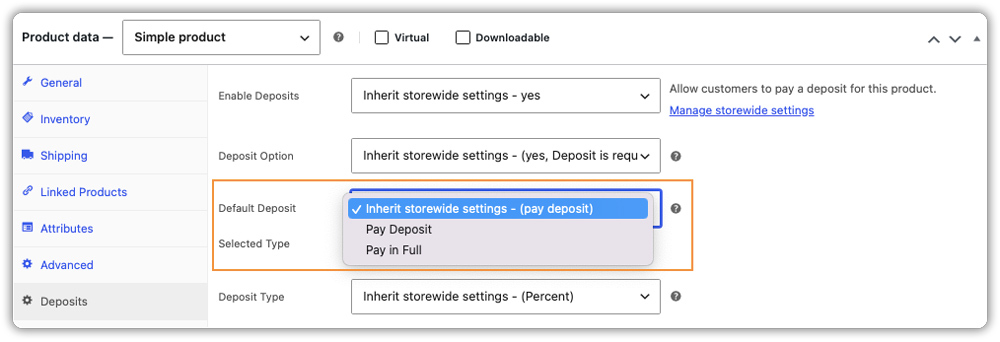
Go to Products → All Products, edit the product, and open the Deposits tab.
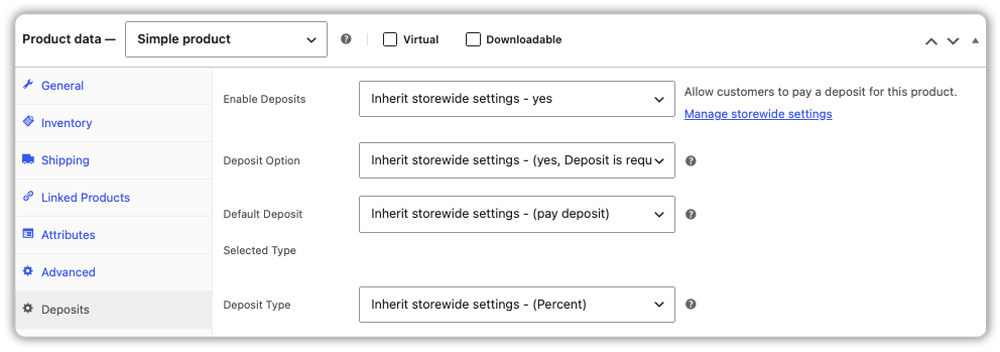
Enable Deposits and Choose the Payment Option
- Enable Deposits – Choose Inherit storewide settings to follow your global setting, or select Yes / No to turn deposits on or off for this specific product.

- Deposit Option – Choose Inherit storewide settings, or set Yes – deposits are optional / Yes – deposits are required for this product.

- Default Deposit Selected Type – Choose Inherit storewide settings, or set whether Pay Deposit or Pay in Full is pre-selected for this product.
Set the Deposit Amount for This Product
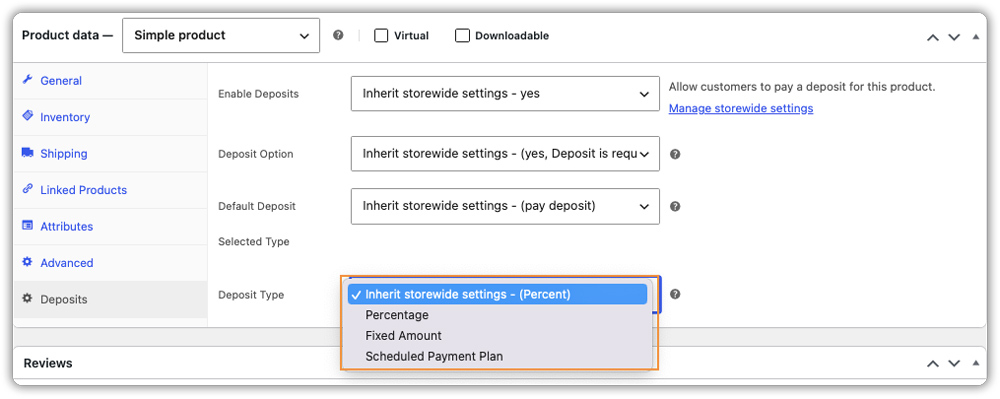
- Deposit Type – Choose Inherit storewide settings, or override it with Percentage, Fixed Amount, or Scheduled Payment Plan for this product.
- Depending on your choice, enter the value in Deposit Percentage Amount or Deposit Fixed Amount, or select from your saved plans under Payment Plans.
Override the Balance Order Delay (Optional)
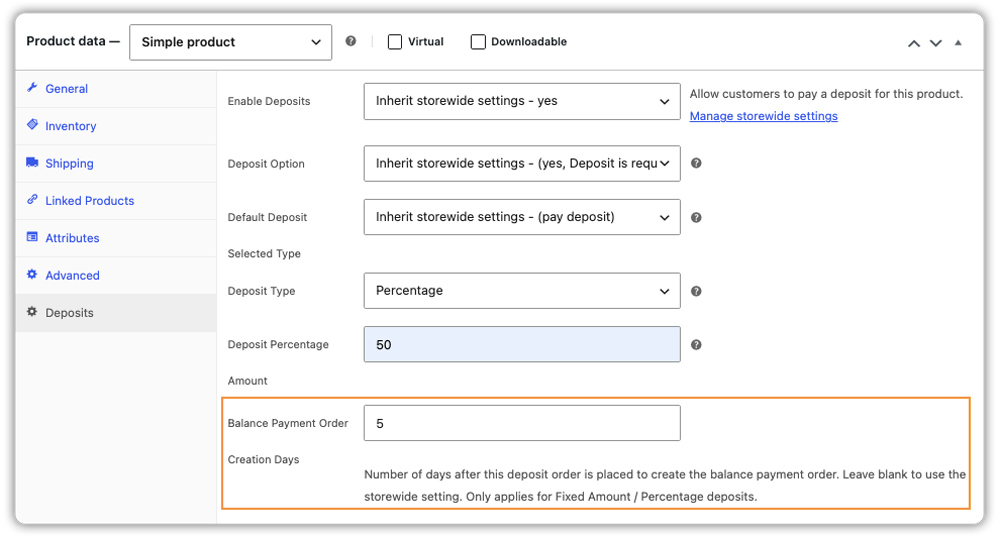
- Balance Payment Order Creation Days – Enter the number of days after the deposit order is placed that the balance payment order should be created for this product. Until you enter a number, the storewide delay is used. This option appears only for Fixed Amount and Percentage deposits.
Set Different Deposits for Individual Variations
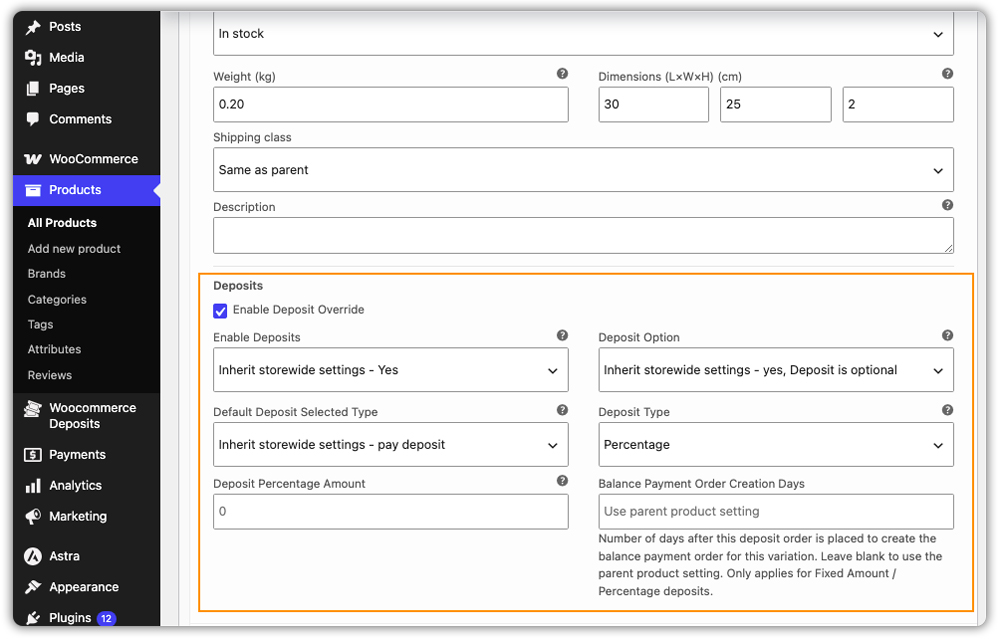
If you sell variable products, the deposit settings on a product’s Deposits tab apply to all of its variations by default. When different variations need different deposit terms – for example, a 20% deposit on a Standard variation but a flat $50 deposit on a Premium one – you can override the deposit settings for each variation individually.
Go to Products → All Products, edit the variable product, open the Variations tab under Product data, and expand the variation you want to customize. At the bottom of the variation, you’ll find a Deposits section.
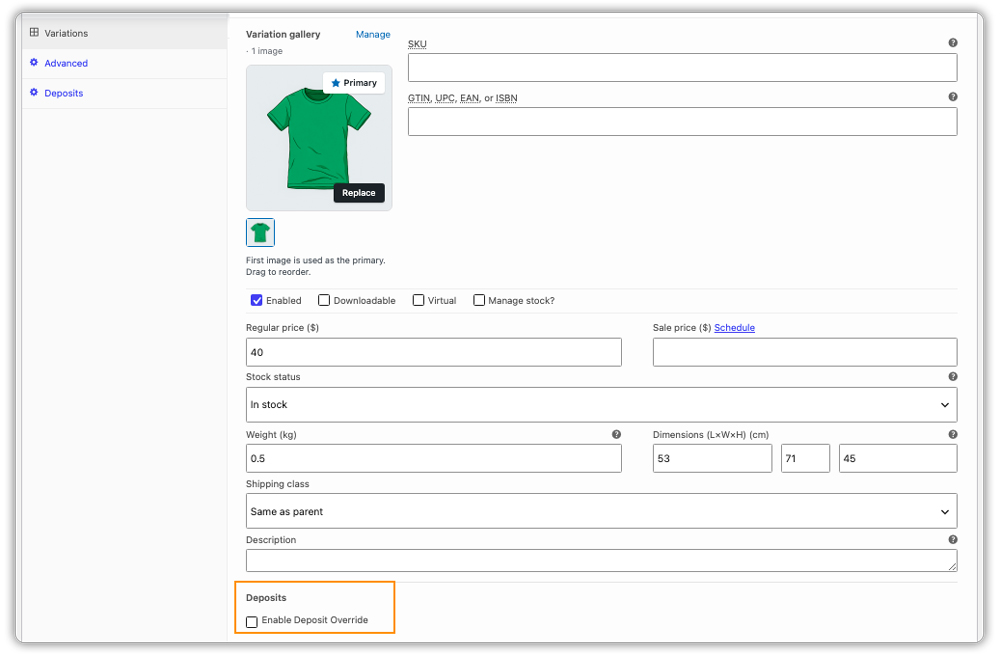
- Enable Deposit Override – Tick this checkbox to turn on the deposit fields for this variation. If it stays unticked, the variation simply follows the product-level settings.
- Enable Deposits – Choose the Inherit option to follow the product’s setting, or select Yes / No to turn deposits on or off for this variation only. A variation can offer deposits even when they are switched off for the rest of the product.
- Deposit Option – Choose the Inherit option, or set Yes – deposits are optional / Yes – deposits are required for this variation.
- Default Deposit Selected Type – Choose the Inherit option, or set whether Pay Deposit or Pay in Full is pre-selected for this variation.
- Deposit Type – Choose the Inherit option, or override it with Percentage, Fixed Amount, or Scheduled Payment Plan for this variation.
- Depending on the Deposit Type you choose, enter the value in Deposit Percentage Amount or Deposit Fixed Amount, or select your saved plans under Payment Plans. For Fixed Amount and Percentage deposits, you can also set Balance Payment Order Creation Days – leave it blank to use the parent product’s setting.
Create Deposit Rules by Category and User Role
If you need different deposit behaviour for groups of products or groups of customers – without editing every product one by one – use Deposit Rules.
Go to WooCommerce Deposits > Settings> Deposit Rules and click Add New Rule.

A rule is built from two independent conditions that you can enable on their own or together:
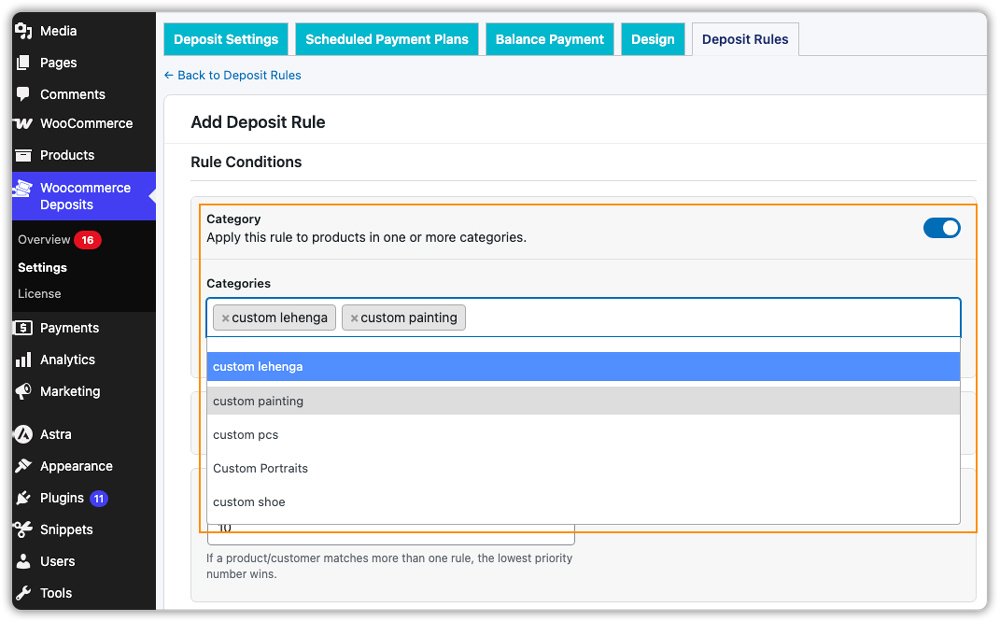
Category condition: Turn on Category, then select one or more product categories from the Categories field. The rule matches a product if it belongs to any of the selected categories.
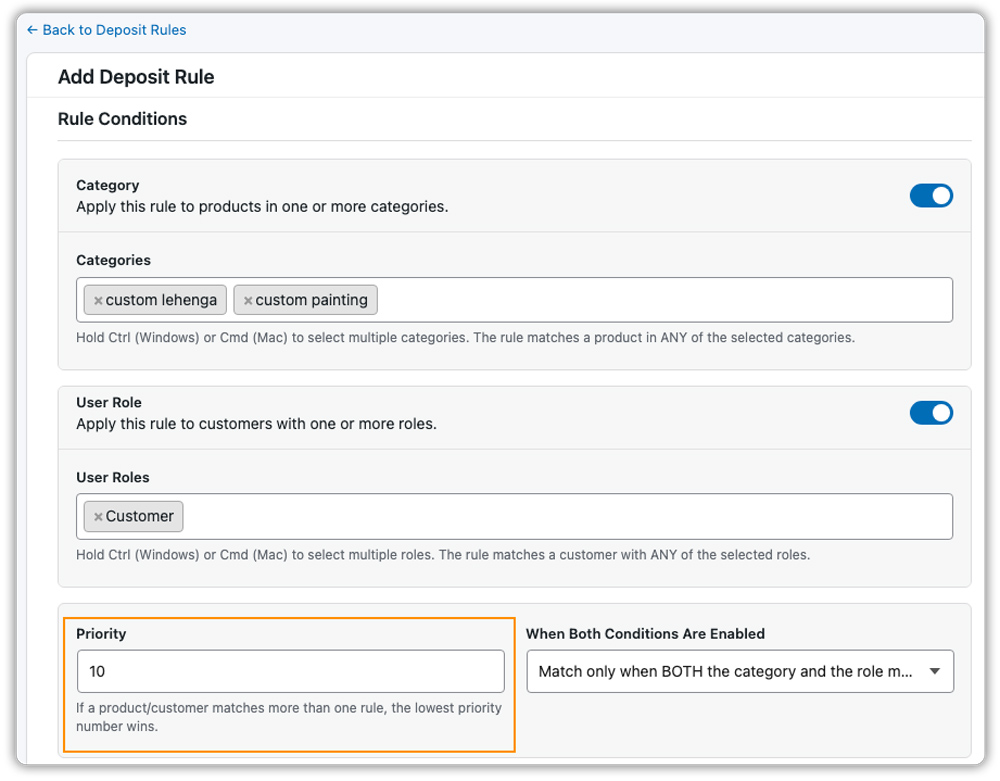
User Role condition: Turn on User Role, then select one or more roles from the User Roles field. The rule matches a customer if they hold any of the selected roles – useful for giving wholesale customers a different deposit rate, or turning deposits off entirely for a specific role.

Combining both conditions: If you enable both Category and User Role on the same rule, a new field appears – When Both Conditions Are Enabled – where you choose the matching logic:
- Match only when BOTH the category and the role match (AND)
- Match when EITHER the category or the role matches (OR)

Priority: If a product or customer matches more than one rule, the Priority field decides which one wins – the lowest priority number takes precedence.
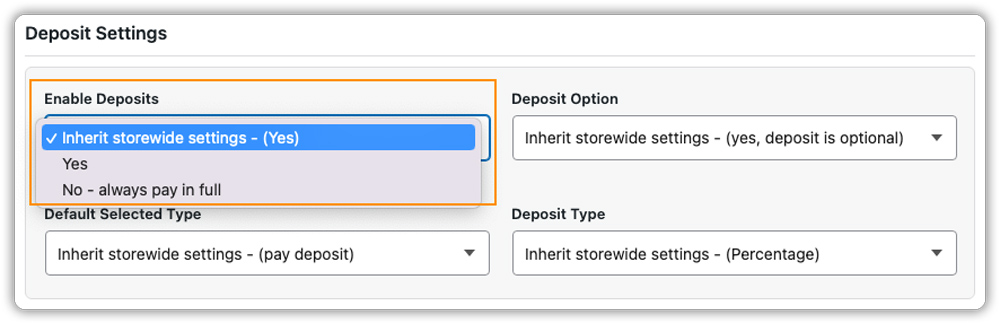
Deposit settings for the rule – Underneath, set the actual deposit behaviour for anything matching this rule. These are the same fields you’d set at the product level:
- Enable Deposits, Deposit Option, and Default Selected Type – same options as covered under Configure Storewide Deposit Settings.

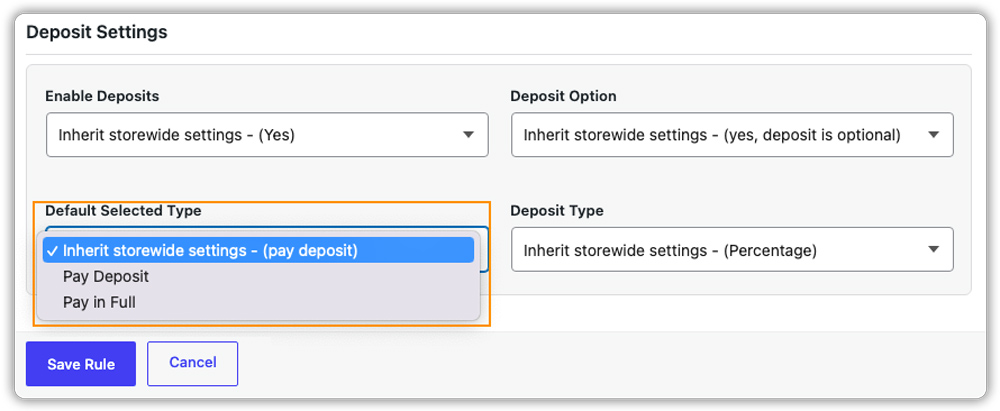
- Deposit Type – Choose how the deposit is calculated for this rule: Percentage, Fixed Amount, or Scheduled Payment Plan.
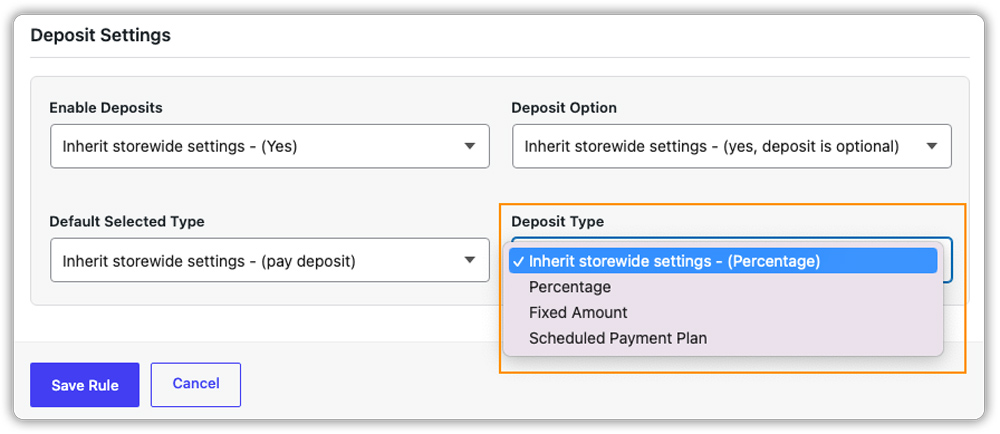
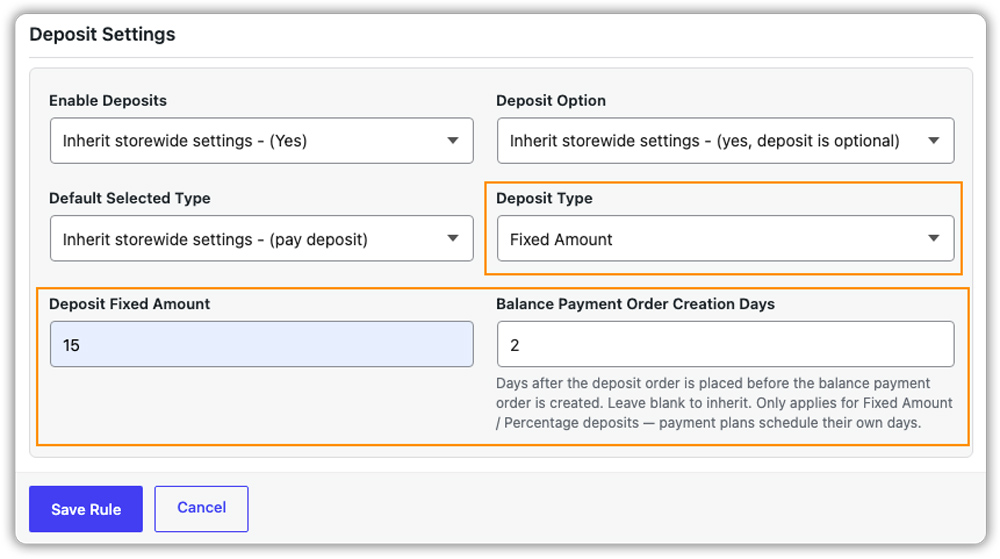
- Depending on your choice, a matching field appears next to it:
- Percentage or Fixed Amount – Enter the value in Deposit Percentage Amount or Deposit Fixed Amount. A Balance Payment Order Creation Days field also appears alongside it, letting you override the balance order delay just for this rule (leave blank to inherit the storewide delay).

- Scheduled Payment Plan – Select one or more saved plans to offer under Payment Plans.
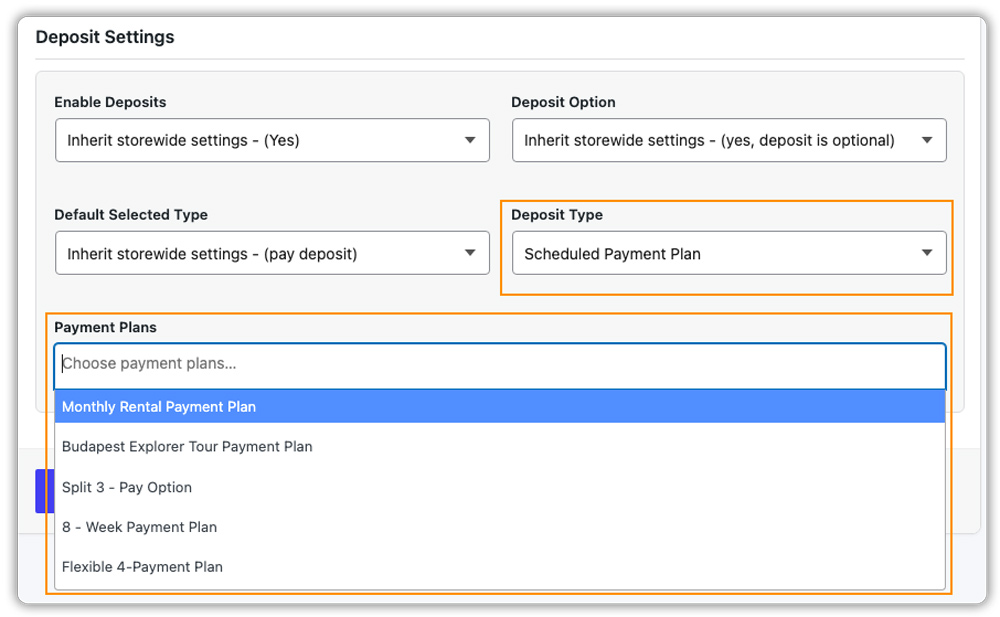
Leaving any field on Inherit storewide settings means it falls back to your global Deposit Settings for that value.
Click Save Rule when you’re done.
Manage Deposit Orders and Orders with Payment Plans
After setting up deposits and payment plans, this section covers how the resulting orders are actually created and managed within WooCommerce – for both you and your customers.
Configure How the Balance Order is Created
Go to the Balance Payment tab, under Balance Payment Order Creation, and choose one of the following:
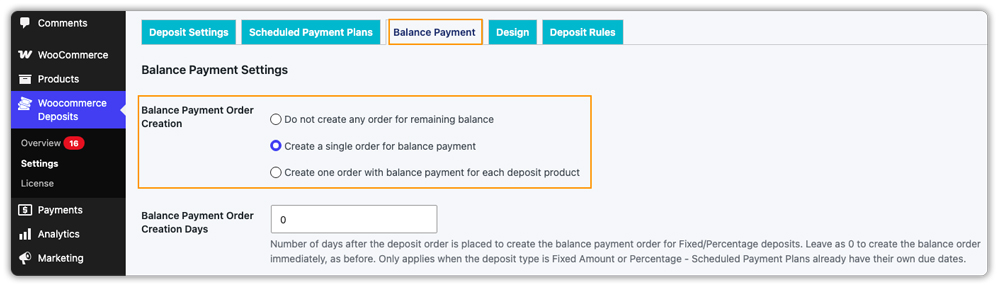
1. Do not create any order for the remaining balance
The plugin calculates the balance and displays it within the same order – no new order is created automatically.

If you need an invoice for the balance, select the order and click Generate Remaining Balance Invoice. This creates a separate order for the balance payment.
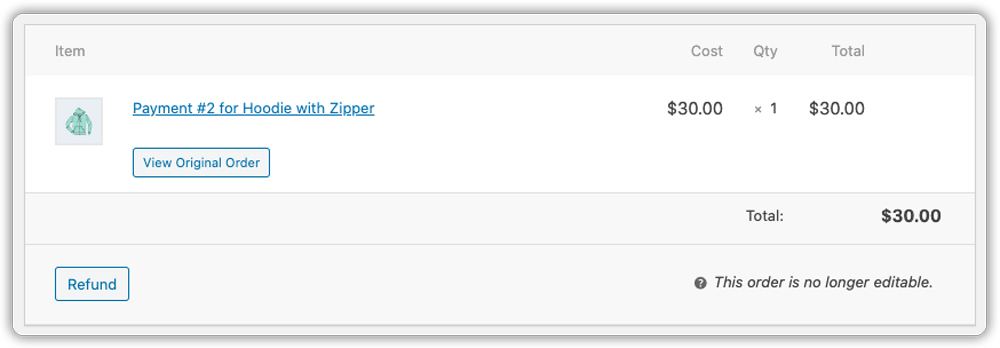
The same invoice will appear on the customer’s My Account page, as shown below.
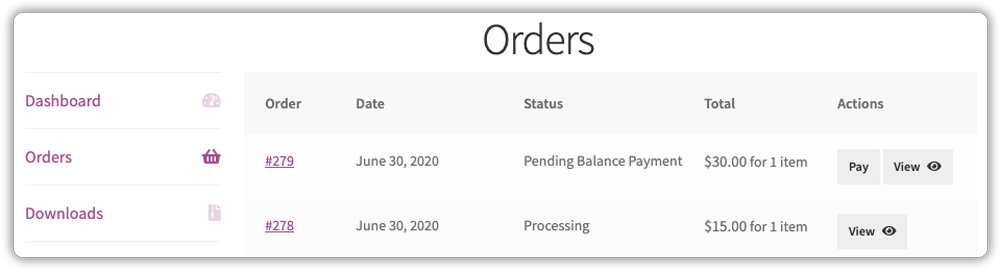
The customer can click on Pay and will be redirected to the payment page for the balance amount for the order

2. Create a single order for the balance payment
The plugin automatically creates one combined balance order for the customer alongside the deposit order – both appear on their My Account page.
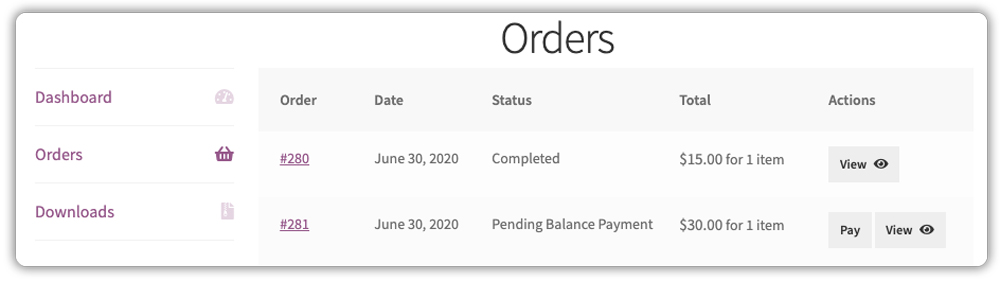
- If a delay is set under Balance Payment Order Creation Days, the order is created immediately but held in a Scheduled Payment status until its due date. It then becomes Pending Balance and payable, and the customer receives the automatic reminder email before the due date (covered under Set Up Reminder Emails for Balance Payments).
- If no delay is set, the order is payable right away from the My Account page, with no automatic email. You can still notify the customer manually using the Send button on the Overview dashboard (covered later in this article).

Customers click Pay to complete the balance amount either way.
3. Create one order with a balance payment for each deposit product
If an order contains multiple products on deposit, the plugin creates a separate balance order for each one individually – useful when different products carry different deposit terms.
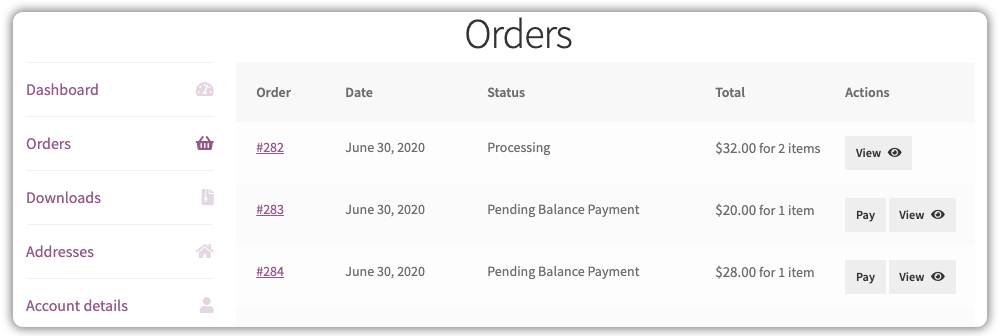
Customers can view and pay for each product’s balance separately from their My Account page. Each order follows the same delay and reminder behaviour described under option 2 above.
Managing Orders with Payment Plans
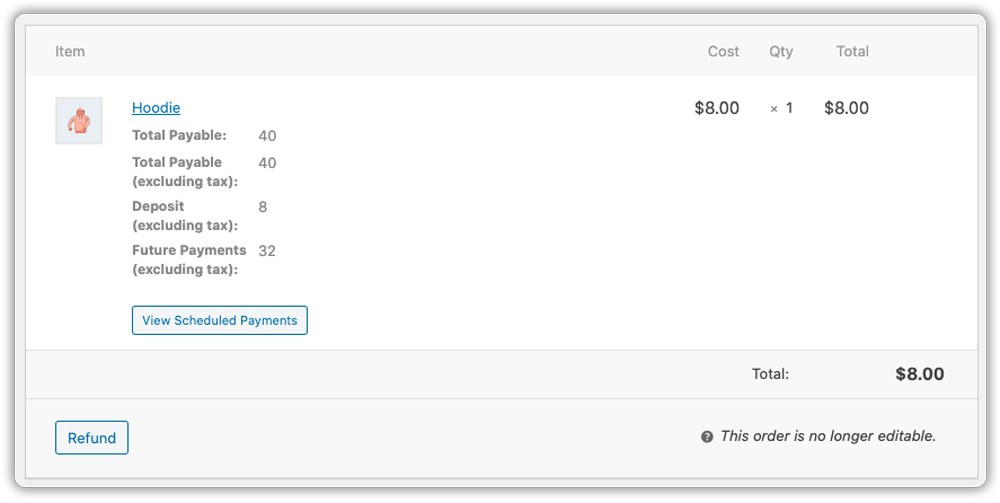
When a customer checks out using a Scheduled Payment Plan, the plugin automatically creates all the scheduled installment orders upfront.
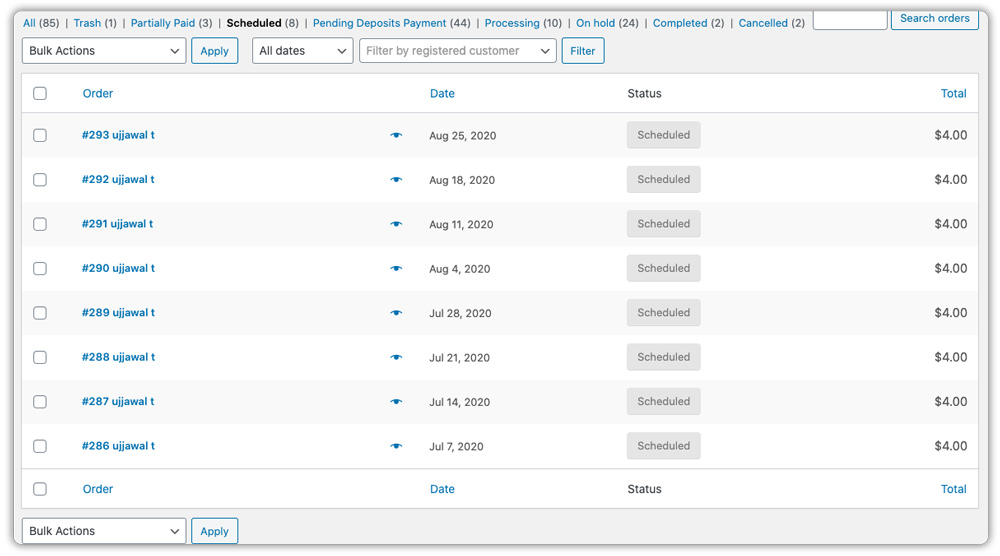
- As the store owner, you can access these from the order page by clicking View Scheduled Payments.
This takes you to the scheduled orders listed on the WooCommerce Orders page.
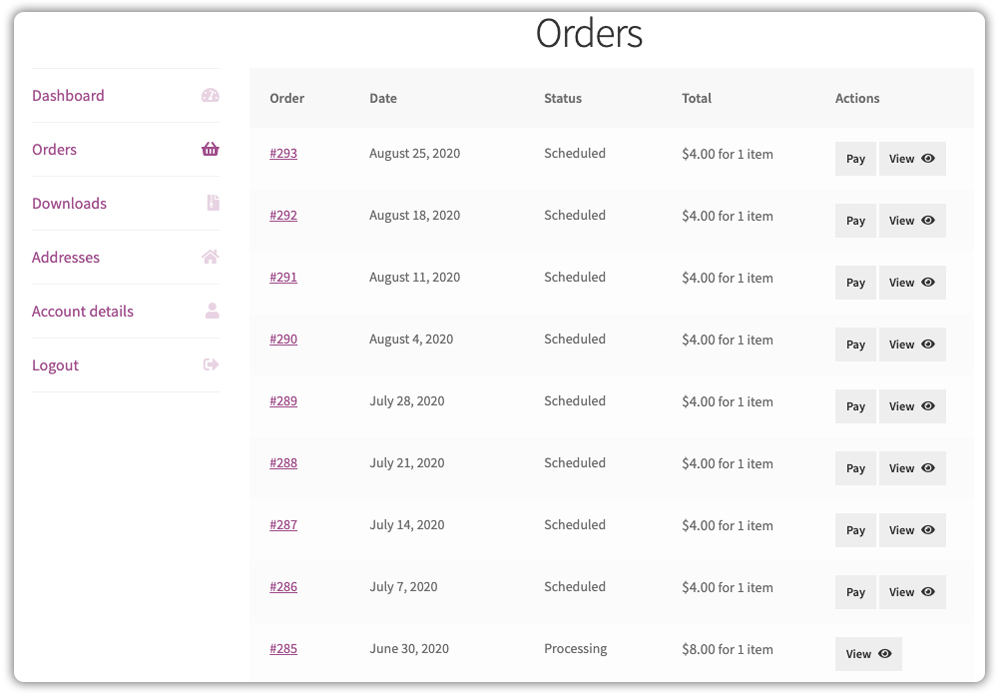
- Customers can view and pay their scheduled installments from the Orders tab on their My Account page.
Automatically Collect the Balance with Stripe (Beta)
Instead of waiting for customers to pay the balance themselves, you can have the plugin automatically charge the remaining balance to the card they used for the deposit on the due date. This feature is currently in Beta and works with Stripe.
Before You Begin
- Install and activate the official WooCommerce Stripe Gateway plugin (by Stripe) on your store.
- Auto Collection charges the balance orders the plugin creates for you, so use it with Scheduled Payment Plans, or with the Create a single order for balance payment or Create one order with balance payment for each deposit product options under Balance Payment Order Creation.
- Customers need to be logged in to opt in, so the option is not shown on guest checkout.
Enable Auto Collection
Go to WooCommerce Deposits → Settings → Auto Collection and configure the following settings:
- Enable Auto Collection – The master switch for the feature. Turn it on to reveal the Payment Methods section.
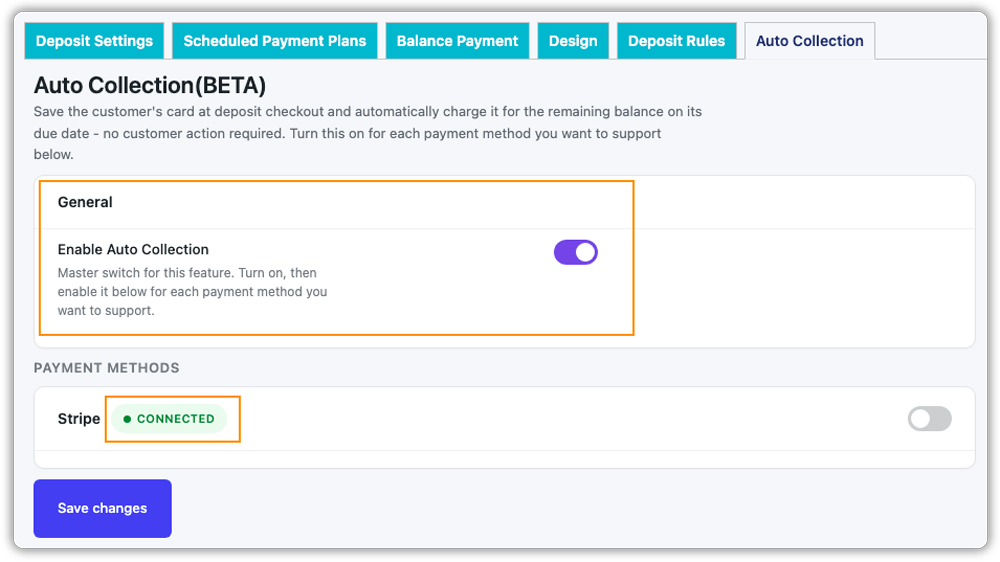
- Stripe – Turn on the toggle in the Stripe card. The card shows a Connected or Not Connected status. If it says Not Connected, install and activate the WooCommerce Stripe Gateway plugin first.
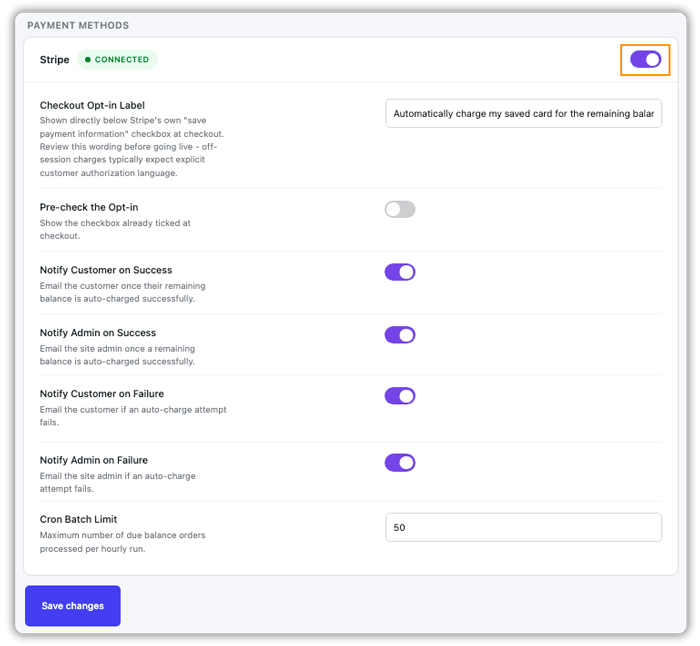
- Checkout Opt-in Label – The text of the checkbox customers see at checkout, directly below Stripe’s own save payment information checkbox. The default is “Automatically charge my saved card for the remaining balance on the due date.” Review the wording before going live, since customers are authorizing a charge they won’t be present for.
- Pre-check the Opt-in – Turn this on to show the checkbox already ticked at checkout.

- Notify Customer on Success / Notify Admin on Success – Send an email once the balance is charged successfully.
- Notify Customer on Failure / Notify Admin on Failure – Send an email if an auto-charge attempt fails.
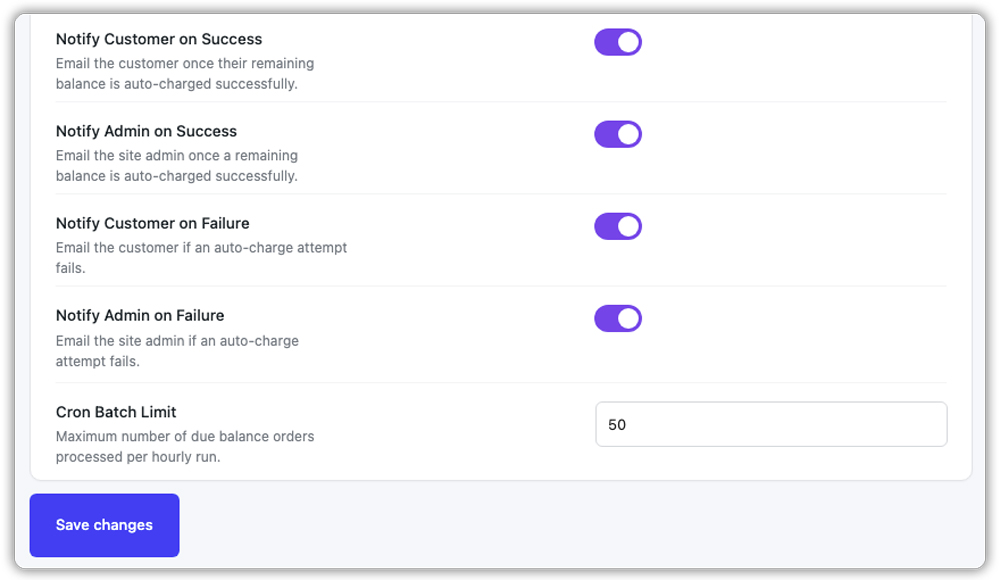
- Cron Batch Limit – The maximum number of due balance orders processed in each hourly run. The default is 50.
Click Save changes once you have configured the settings.
How Auto Collection Works for Customers
- At checkout, a logged-in customer paying the deposit with Stripe sees the opt-in checkbox below Stripe’s save payment information option. Ticking it saves their card for the balance.

- The same opt-in appears next to the Apple Pay, Google Pay, and Link express buttons.

What Happens on the Due Date
- On the due date, the plugin automatically charges the saved card for the remaining balance. Due balance orders are checked every hour.
- If the customer does not opt in, or their card cannot be reused, nothing changes. The balance follows the normal flow, with the reminder email and payment link.
Emails Customers Receive
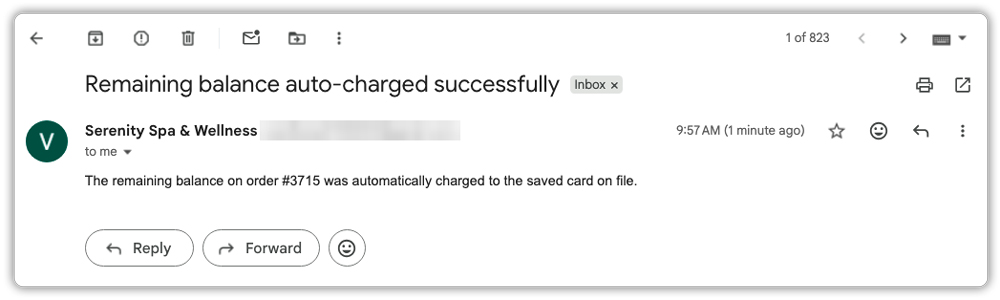
- Successful charge – If Notify Customer on Success is on, the customer receives an email confirming that the remaining balance was automatically charged to their saved card.
- Failed charge – If Notify Customer on Failure is on, the customer receives an email saying the automatic payment could not be completed. It includes a link to pay the balance manually.
What Merchants See and Receive
Emails you receive
- Successful charge – If Notify Admin on Success is on, the site admin receives an email when a balance is charged successfully.
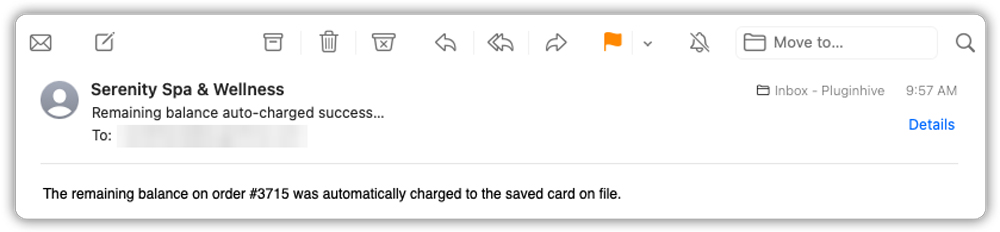
- Failed charge – If Notify Admin on Failure is on, the site admin receives an email when an attempt fails. It includes the customer’s payment link.
Order notes
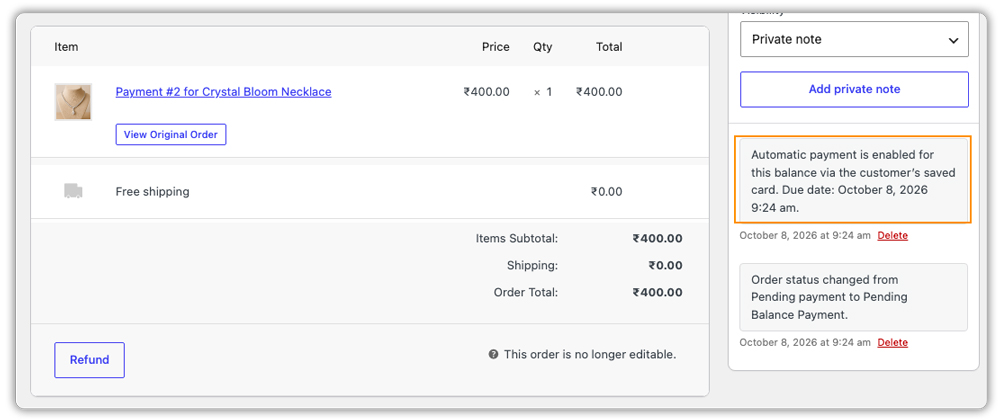
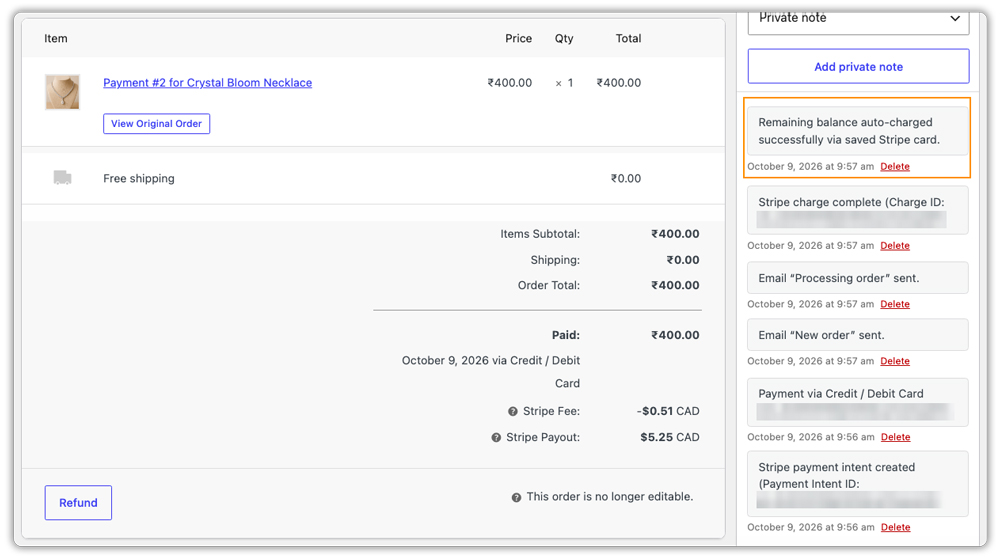
Each step is recorded as an order note on the balance order, so you can see what happened without opening Stripe:
- Auto-charge enabled – Added when the balance order is created for an opted-in customer, with the due date.
- Successful charge – The balance order is marked as paid, and a note confirms the charge.
- Failed charge – A note records the failure and the reason Stripe gave. This covers a declined card, a card that needs authentication, or no reusable card found.
- Card could not be saved – If the card used for the deposit was not saved in Stripe, a note on both the deposit and balance orders says the balance must be paid manually.
If a Charge Fails or Is Still Processing
- Failed charge – The plugin makes one auto-charge attempt per balance order and does not retry. The customer can pay the balance manually using the link in the failure email.
- Still processing – If Stripe accepts the charge but has not finished it yet, the order updates automatically once Stripe confirms the payment. No failure email is sent in this case.
Track deposits from the Overview dashboard
The plugin includes a dedicated dashboard for monitoring deposit performance and managing balance payments, without digging through individual WooCommerce orders.
Go to WooCommerce Deposits > Overview.
Summary cards
At the top, you’ll see stat cards summarizing your store’s deposit activity:
- Deposit Revenue – total deposit amount collected
- Total Remaining Balance – total balance still outstanding
- Deposit Orders – total number of deposit orders placed
- Overdue Orders – balance payments past their due date
- Paid Orders – fully paid deposit orders
- Partially Paid Orders – orders with some installments paid and others still pending

Below the cards, a Revenue Timeline chart shows collected vs. expected revenue over time, with Presets (e.g. last 7/30 days) or a Custom date range you can set with From and To dates. You can also expand View as table for the same data in a plain table.

Deposit Order Details table
Switch to the Deposit Order Details tab for a full, filterable list of every deposit order.
Use the tabs above the table to filter by status: All, Parent Orders, Balance, Upcoming, Overdue, Paid Orders, and Partially Paid. You can also search by customer name, email, or order number using Search orders.

Each row shows the Order, Order Status, Customer, Balance (or Paid Amount on the Paid Orders view), Due Date, and Status (Completed / Overdue / Upcoming, with a “due in X days” or “overdue by X days” caption).
For orders still awaiting payment, two additional columns give you quick actions:
- Reminder – a Send button to manually send the balance payment reminder email on demand, showing when it was last sent (e.g. “Last sent 2 days ago” or “No reminder sent yet”). You can also select multiple rows and use the Send Reminder bulk action.
- Action – a Mark as Paid button, for recording payments collected outside the plugin (e.g. bank transfer, cash, or a manual card charge) so the order reflects the correct status without the customer needing to pay through checkout.
Customize the Deposit Payment Design on Product Pages
The plugin lets you customize how the deposit and full payment options are displayed on your product pages. Go to WooCommerce Deposits → Settings → Design to configure this.
- Choose Your Design – Select between Design-1 and Design-2. As soon as you select one, a preview image updates below the dropdown so you can see how the layout will look to customers before saving.
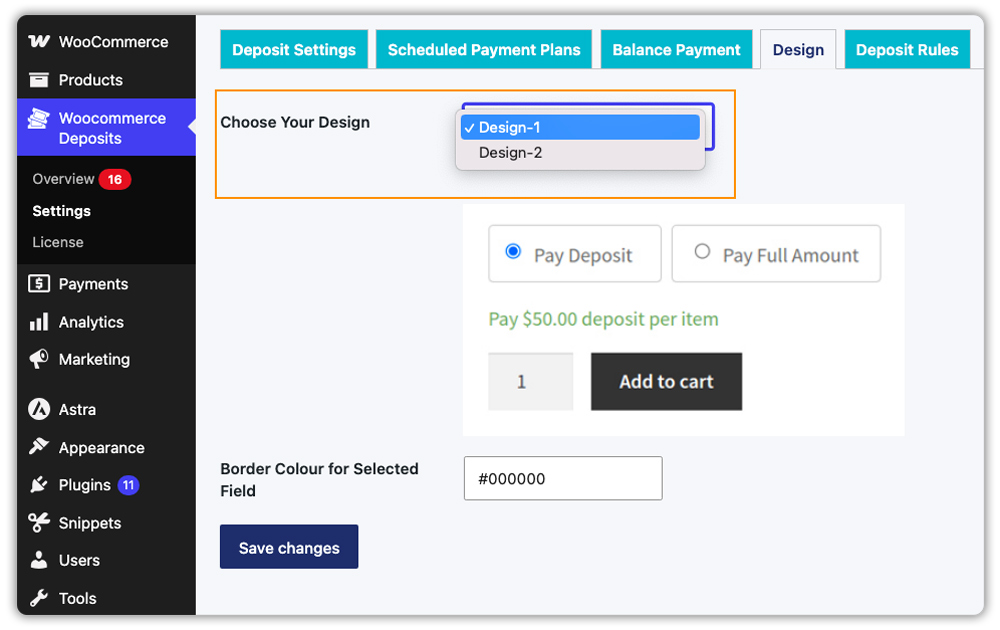
- Border Colour for Selected Field – Enter a hex color code (e.g. #000000 for black), or use the built-in color picker, to set the highlight color shown around whichever payment option – Pay Deposit or Pay Full Amount – the customer has selected. This is useful for matching the highlight to your store’s branding.
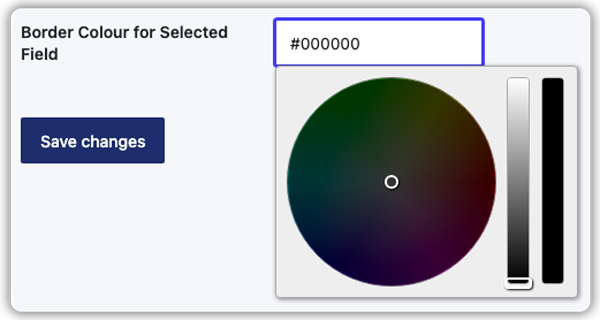
Click Save changes once you’ve chosen your design and color.
Usage – How Deposit Details Appear to Customers
Once deposits or payment plans are enabled, customers see a breakdown of what they owe now and later at every stage of their purchase – not just on the product page.
On the Cart and Checkout Pages
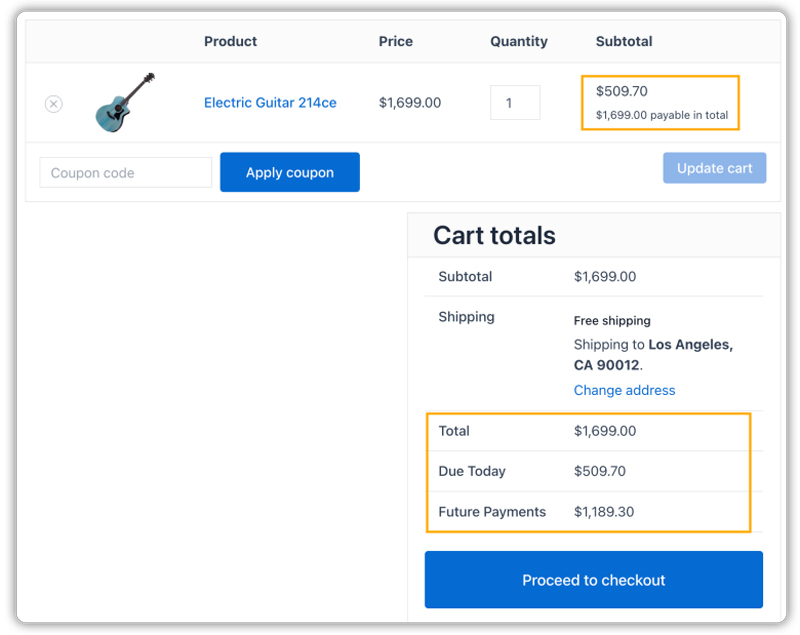
Alongside the regular order total, the plugin adds two rows:
- Due Today – The amount payable right now (the deposit or first installment).
- Future Payments – The remaining amount still owed. If a coupon or discount applies to the future payments, a Discount Applied Toward Future Payments row is also shown.
Cart page :
Checkout page :
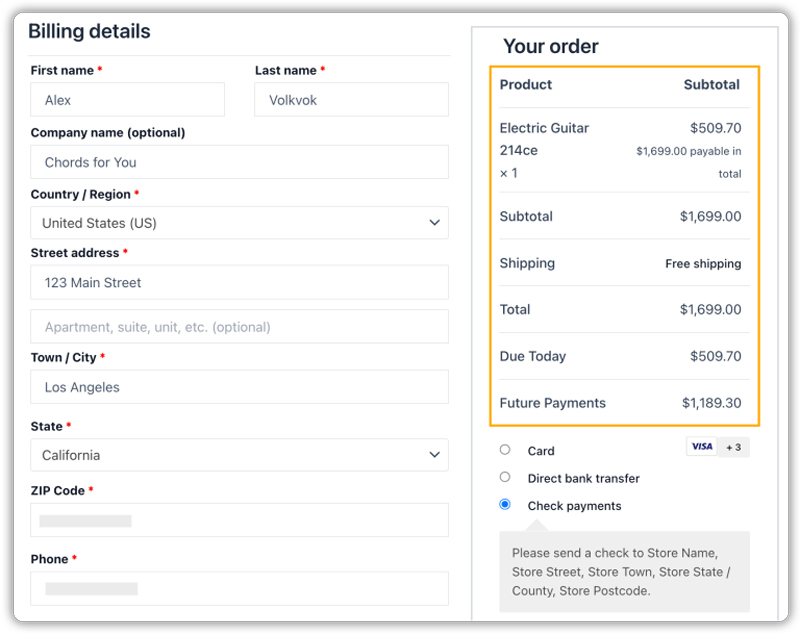
On the Order Received (Thank You) Page and in the Order Confirmation Email
The same breakdown carries through after checkout:
- Amount Paid – Shown once the initial payment (deposit or first installment) is completed.
- Future Payments – The amount still due, so the customer knows what’s left to pay.

This keeps customers informed about their remaining balance at every step, without needing to check back with you and gives them a written record (via the confirmation email) of exactly what’s been paid and what’s still outstanding.

We hope this article has helped you set up the PH Deposits for WooCommerce plugin on your WooCommerce website. If you have trouble using it or need help setting it up, feel free to contact PluginHive Support. Our team will definitely help you out.